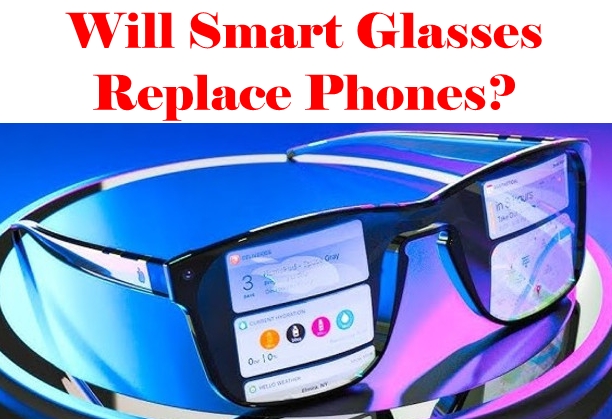
Will Smart Glasses Replace Phones?
Introduction
As technology continues to evolve at an unprecedented pace, the potential for smart glasses to replace smartphones is increasingly a topic of discussion. With companies like Meta, Google, Microsoft, Apple, and Snap investing heavily in this arena, the question arises: Are we on the brink of a shift from handheld devices to wearable technology?
The Rise of Smart Glasses
Smart glasses have come a long way since their initial introductions. Google Glass launched in 2013, offering a glimpse into augmented reality (AR), but faced criticism over privacy issues and usability. Today, numerous projects are emerging, indicating a renewed interest in smart glasses as a viable alternative to smartphones.
Key Smart Glasses Projects
- Meta’s Project Orion
- Meta’s Project Orion aims to create advanced AR glasses that integrate seamlessly with the Facebook ecosystem. With features like real-time translation and contextual information display, the project seeks to enhance social interactions. As of 2023, Meta has invested over $10 billion in AR/VR technologies, showcasing their commitment to this future.Features:
- Advanced AR capabilities, including real-time translation and contextual overlays.
- Integration with Meta’s social platforms (Facebook, Instagram).
- Hands-free controls via voice commands and gestures.
Pros:
- Seamless connectivity with existing Meta products enhances user experience.
- Potential for immersive social interactions and experiences.
- Strong backing from Meta, indicating ongoing development and support.
Cons:
- Privacy concerns due to data collection and social media integration.
- Dependency on Meta’s ecosystem may limit appeal to non-users.
- Current prototypes may face technical limitations, including battery life.
- Meta’s Project Orion aims to create advanced AR glasses that integrate seamlessly with the Facebook ecosystem. With features like real-time translation and contextual information display, the project seeks to enhance social interactions. As of 2023, Meta has invested over $10 billion in AR/VR technologies, showcasing their commitment to this future.Features:
- Google Glass
- Originally targeted at developers and enterprises, Google Glass has evolved with the introduction of the Glass Enterprise Edition 2. This version focuses on improving productivity in work environments, with applications in manufacturing and healthcare. For instance, a study showed that using Google Glass can increase productivity by up to 15% in assembly line tasks.Features:
- Lightweight design with a small display for notifications and information.
- Voice-activated controls and a built-in camera for hands-free capture.
- Focus on enterprise applications, with software tailored for specific industries.
Pros:
- Proven productivity increase in enterprise settings (up to 15%).
- Durable and designed for rugged environments, suitable for industries like manufacturing.
- Continual updates with the Enterprise Edition enhance functionality.
Cons:
- Early consumer model faced backlash over privacy issues (e.g., “Glassholes”).
- Limited appeal in the consumer market due to its enterprise focus.
- Small display and limited functionality compared to smartphones.
- Originally targeted at developers and enterprises, Google Glass has evolved with the introduction of the Glass Enterprise Edition 2. This version focuses on improving productivity in work environments, with applications in manufacturing and healthcare. For instance, a study showed that using Google Glass can increase productivity by up to 15% in assembly line tasks.Features:
- Microsoft HoloLens
- Launched in 2016, HoloLens is primarily aimed at businesses and developers, offering a mixed reality experience. It has been used in various sectors, including healthcare and construction. Notably, a case study showed that surgeons using HoloLens could reduce operating times by up to 30%, demonstrating its practical benefits in critical environments.Features:
- Mixed reality experience combining digital and physical environments.
- High-resolution holographic display and spatial audio capabilities.
- Enterprise-focused applications, particularly in healthcare and engineering.
Pros:
- Significant improvements in specific professional fields (e.g., surgery, design).
- Allows for collaboration through shared digital environments.
- Robust software development kit (SDK) supports a wide range of applications.
Cons:
- High price point (around $3,500), limiting accessibility for average consumers.
- Bulky design compared to other wearable tech, reducing everyday use appeal.
- Battery life is relatively short, affecting long-duration use.
- Launched in 2016, HoloLens is primarily aimed at businesses and developers, offering a mixed reality experience. It has been used in various sectors, including healthcare and construction. Notably, a case study showed that surgeons using HoloLens could reduce operating times by up to 30%, demonstrating its practical benefits in critical environments.Features:
- Apple Vision Pro
- Set to launch in 2024, Apple’s Vision Pro is highly anticipated. It aims to blend AR and virtual reality (VR) for an immersive user experience. With a reported investment of $15 billion in AR technology, Apple is positioning itself as a leader in this space, focusing on seamless integration with its existing ecosystem.Features:
- A blend of AR and VR with immersive experiences.
- High-definition displays and advanced eye-tracking technology.
- Integration with Apple’s ecosystem (iOS, macOS) for seamless functionality.
Pros:
- Strong brand recognition and user loyalty can drive adoption.
- Potential for a wide range of applications, from entertainment to productivity.
- User-friendly interface and design aligned with Apple’s aesthetic.
Cons:
- Expected high cost may deter early adopters (estimated over $3,000).
- Competition with established products may pose challenges for market penetration.
- Uncertain long-term utility; users may need time to adapt to new technology.
- Set to launch in 2024, Apple’s Vision Pro is highly anticipated. It aims to blend AR and virtual reality (VR) for an immersive user experience. With a reported investment of $15 billion in AR technology, Apple is positioning itself as a leader in this space, focusing on seamless integration with its existing ecosystem.Features:
- Snap Spectacles
- Snap’s latest iteration of Spectacles focuses on social media integration, allowing users to capture and share moments easily. The 2023 version includes features like augmented reality filters. While still niche, Snap has sold over 200,000 pairs of Spectacles since their launch, highlighting consumer interest in wearable technology.Features:
- Designed primarily for capturing photos and videos with integrated AR features.
- Lightweight and fashionable design aimed at younger audiences.
- Integration with Snapchat for easy sharing and social interaction.
Pros:
- Appeals to social media users, enhancing user-generated content.
- Compact and stylish, making them more wearable than other models.
- Regular updates and new iterations keep the product fresh.
Cons:
- Limited functionality beyond capturing content, making them less versatile.
- Niche market focus may restrict broader adoption.
- Concerns about privacy and public perception similar to Google Glass.
- Snap’s latest iteration of Spectacles focuses on social media integration, allowing users to capture and share moments easily. The 2023 version includes features like augmented reality filters. While still niche, Snap has sold over 200,000 pairs of Spectacles since their launch, highlighting consumer interest in wearable technology.Features:
This detailed breakdown offers a comprehensive look at each project’s strengths and weaknesses, helping to contextualize their potential in the smart glasses landscape.
Technological Features
Comparing these five projects reveals a spectrum of functionalities. Meta’s Orion focuses on social integration, while Google Glass targets enterprise productivity. Microsoft’s HoloLens stands out for its mixed reality capabilities, while Apple aims for a comprehensive AR experience. Snap’s approach is more casual and social. Overall, the diversity in design reflects the varied market needs.
Smart glasses leverage a combination of advanced technologies, including augmented reality (AR), artificial intelligence (AI), sensors, and connectivity features. Each project utilizes these technologies to varying degrees, enhancing functionality and user experience.
1. Augmented Reality (AR)
AR technology overlays digital information onto the real world, allowing users to interact with both simultaneously. Smart glasses use:
- Micro-displays: Miniature screens (like OLED or LCD) project images directly onto the lenses, creating an immersive experience.
- Depth sensors: These detect the distance between the user and objects in the environment, enabling accurate placement of digital elements.
- Cameras: Front-facing cameras capture the environment, providing input for AR applications to analyze and respond in real-time.
2. Artificial Intelligence (AI) Integration
AI plays a crucial role in enhancing the functionality of smart glasses through:
- Voice Recognition: AI-powered voice assistants (like Meta’s voice control or Google Assistant) enable hands-free operation, allowing users to give commands and receive responses without touching the device.
- Contextual Awareness: Machine learning algorithms analyze user behavior and environmental context, delivering relevant information and notifications. For example, if a user looks at a landmark, the glasses can provide historical data or directions.
- Image Recognition: AI algorithms identify objects, faces, or text in real-time, facilitating applications such as instant translation of written signs or identifying people in social contexts.
3. Sensors and Connectivity
Smart glasses integrate various sensors to enhance user interaction:
- Gyroscopes and Accelerometers: These track head movements and orientation, allowing for intuitive navigation through menus or applications.
- GPS and Location Services: Integrated GPS enables location-based features, such as navigation directions or localized information.
- Bluetooth and Wi-Fi Connectivity: Smart glasses connect to smartphones and the internet, allowing for data synchronization, app integration, and real-time updates.
4. User Interface Design
The user interface (UI) in smart glasses is critical for usability:
- Gesture Recognition: Some smart glasses utilize gesture control, allowing users to interact by swiping or tapping in the air, enhancing hands-free functionality.
- Augmented Displays: Notifications, messages, and AR overlays are displayed contextually, allowing users to maintain focus on their surroundings while accessing digital content.
5. Battery Management and Performance
Advanced battery technology is essential for practical usage:
- Energy-efficient Components: Smart glasses use low-power displays and processors to extend battery life.
- Dynamic Power Management: AI can optimize battery usage by adjusting performance based on user activity and preferences, ensuring the device runs efficiently.
The technological features of smart glasses represent a convergence of cutting-edge technologies, enhancing user experience and functionality. With ongoing advancements in AI, AR, and sensor technology, smart glasses are poised to become increasingly capable and integral to daily life, making them a compelling alternative to traditional smartphones.
Advantages and Challenges of Smart Glasses
The advantages of smart glasses are compelling. Users can access information hands-free, receive notifications, and navigate without interrupting their activities. Studies suggest that hands-free devices can improve multitasking efficiency by 20%, making them particularly appealing in fast-paced environments.
Despite their potential, smart glasses face significant challenges. Privacy concerns loom large; incidents of users recording without consent have led to public backlash against devices like Google Glass. Technical limitations, including battery life (often lasting only a few hours), and display quality also hinder widespread adoption. Moreover, societal acceptance remains a hurdle, as many consider smart glasses less fashionable compared to smartphones.
Future Prospects
Looking ahead, predictions suggest that smart glasses could become mainstream within the next five to ten years. If companies can address current challenges and improve user experience, a scenario where smart glasses coexist with or even replace smartphones becomes plausible.
Conclusion
Smart glasses represent an exciting frontier in personal technology, with major tech companies investing heavily in their development. While challenges remain, the potential benefits—such as enhanced usability and multitasking capabilities—make them a promising alternative to smartphones. As technology advances and societal acceptance grows, smart glasses may well redefine how we interact with the digital world.
Case Study: Orion project from Meta
At Meta Connect this year, Zuckerberg unveiled the Project Orion, a pair of AR smart glasses.

Despite all the high-end technology packed into the frame, these hologram-generating glasses almost resemble regular eyewear, bearing a striking similarity to Meta’s Ray-Bans.
The Orion glasses pack in a host of features like eye-tracking, hand-tracking, voice controls, and even a neural interface, although it reads signals from your wrist rather than your brain.
The glasses also come with a wireless compute puck that resembles a sleek power bank. While they don’t require a laptop or phone to operate, the puck must be within a few feet for them to function, which means you’ll likely need to carry it in your pocket.
Multiple newspapers put the cutting-edge hardware on trial at the occasion. Renowned for his support of AI, NVIDIA CEO Jensen Huang had the opportunity to try on the Orion eyewear. He exclaimed, “The field of view is excellent, the brightness is good, the color contrast is good, and the head tracking is good.”
While Google Glass may have been an expensive failure for tech giant Google, it was a valuable case study for the remainder of the tech sector. It gave the developers a wealth of knowledge about what consumers dislike, and those insights helped to shape the current generation of smart eyewear.
To make matters worse, the majority of modern smart glasses have a far more understated appearance, but this one did look like a prop from “The Matrix.” Wearers can avoid being labeled as contemporary “glassholes” for attempting to record people without their permission—even if it doesn’t actually stop this from happening).
Meta envisions that within the next ten years, up to 2 billion people who wear regular glasses will transition to the smart ones, with even those who don’t need thema medically, eventually adopting them.
While the smart glasses market is growing, That the item will ever become widely used, much less take the place of smartphones as our preferred personal device, is still uncertain. This may be the one smart glass function that Google got right with Google Glass, even though the industry is still looking for the “killer app”—a feature that would let users access everything with a single tap.
Ray-Ban Meta, which was created in collaboration with Meta, is Zuckerberg’s “normal-looking glasses with a camera, microphone, and great audio that can stream video and capture content without a display.” However, he emphasized that AI was the most crucial component for smart glasses and defined Ray-Ban Meta, which has access to Meta AI, as ‘on the path to producing a complete holographic pair of spectacles’.
Zuckerberg also emphasized the enormous technological challenges in creating AR glasses that can provide a smooth experience. Developing a small form factor and incorporating interactive features like holographic displays is one of these problems.
According to his vision, subsequent versions might become accessible by 2027, provided that technical developments result in reduced production costs and improved functionality.
Instead of racing to market with an unfinished product, they are now concentrating on internal development and technological demonstration.