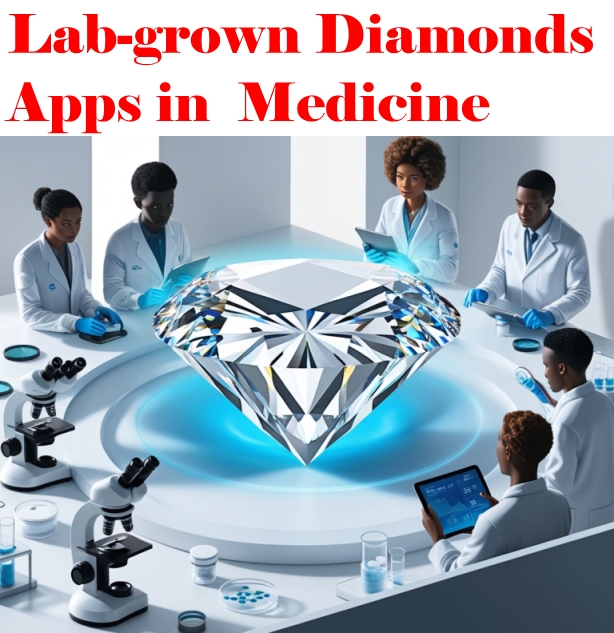
Growing role of Lab-grown Diamonds in Medicine and Electronics Apps
Lab-grown diamonds are increasingly being utilized in medicine, electronics, and scientific research due to their unique properties such as extreme hardness, chemical stability, and thermal conductivity.
Even with a jeweler’s glass, it can be difficult to tell the difference between natural and lab-grown diamonds due to their chemical and physical similarities.
Often the only way to definitively distinguish lab-grown from natural diamonds is by using specialist equipment that measures the molecular characteristics of a diamond such as absorption spectroscopy or photoluminescence.
While traditionally associated with jewelry, Lab-grown diamond applications in medicine and science are expanding rapidly. Here’s an overview of their growing role in these fields:
Applications in Medicine
- Medical Imaging and Diagnostics:
- Quantum sensors based on lab-grown diamonds are being developed for high-resolution imaging and MRI machines. These sensors use nitrogen-vacancy (NV) centers within diamonds to detect weak magnetic fields, enabling detailed imaging of soft tissues and brain function.
- Diamonds’ biocompatibility makes them ideal for sensitive diagnostic equipment, offering greater precision in detecting early-stage diseases like cancer and cardiovascular diseases.
- Drug Delivery:
- Lab-grown nanodiamonds are being explored for targeted drug delivery systems. Their surface can be functionalized to bind to specific molecules, allowing them to carry drugs or gene therapies directly to affected tissues, minimizing side effects and improving the efficiency of treatment.
- Research shows that nanodiamonds can enhance the effectiveness of chemotherapy by helping drugs penetrate cancer cells more efficiently.
- Biosensors:
- Diamond-based biosensors are under development to monitor real-time changes in biological systems, such as detecting glucose levels in diabetic patients or monitoring pH levels in wounds to detect infections.
- Diamonds’ chemical stability and resistance to corrosion make them suitable for long-term implants in the human body for continuous monitoring.
Applications in Scientific Research
- Quantum Computing:
- Lab-grown diamonds are integral to the development of quantum computers. The NV centers in diamonds serve as quantum bits (qubits), the building blocks of quantum computing, due to their ability to maintain quantum states at room temperature.
- Diamond quantum sensors are being used in experiments to detect and manipulate atomic-scale magnetic fields, which is crucial for advancing quantum computing technologies.
- High-Pressure Research:
- Lab-grown diamonds are used in diamond anvil cells (DACs) to simulate extreme pressures found deep within the Earth’s core or in outer space. These diamonds can withstand immense pressure, enabling scientists to study the behavior of materials under extreme conditions.
- DACs are pivotal in fields like geology, materials science, and planetary science to investigate new materials and simulate planetary interiors.
- Thermal Management:
- Due to their superior thermal conductivity, lab-grown diamonds are employed as heat sinks in high-powered scientific equipment, lasers, and semiconductors. They effectively dissipate heat in environments requiring extreme temperature control, enhancing the performance of these devices.
- Optics and Lasers:
- In optical applications, synthetic diamonds are used to create high-precision lenses for laser systems and scientific instruments. Diamonds’ ability to transmit light across a wide spectrum and withstand extreme conditions makes them ideal for high-power laser cutting and surgical lasers.
- They also improve the performance of X-ray diffraction equipment, which is essential in materials science and biological research.
Benefits of Lab-Grown Diamonds in Medicine and Science
- Biocompatibility: Lab-grown diamonds are non-toxic and biocompatible, making them ideal for medical implants and drug delivery systems.
- Precision: Diamonds’ hardness and stability allow for the creation of ultra-precise instruments for diagnostics, imaging, and surgery.
- Quantum Properties: NV centers in diamonds make them suitable for quantum computing, magnetic resonance imaging (MRI), and high-resolution sensing.
Future Potential
- Advanced Cancer Therapies: Nanodiamonds could be used in conjunction with immunotherapy or personalized medicine, improving the effectiveness of treatments.
- Brain-Computer Interfaces: Diamond-based quantum sensors could enable non-invasive brain monitoring, paving the way for breakthroughs in neuroscience and brain-computer interfaces.
- Next-Generation Computing: The quantum properties of lab-grown diamonds hold promise for the future of quantum computing and artificial intelligence, offering unparalleled computational power for scientific research.
Examples of Applications in Medicine and Science
Here’s a detailed breakdown of lab-grown diamonds’ applications in medicine and scientific research, complete with examples, data, relevant products, research projects, and the pros and cons of each application.
1. Medical Imaging and Diagnostics
Examples & Projects:
- Harvard University is pioneering research using NV (Nitrogen-Vacancy) diamond sensors for MRI machines, allowing for high-resolution imaging of tissues without the need for strong magnetic fields. These sensors offer nano-level sensitivity to magnetic fields, enhancing brain and heart imaging.
- Qnami, a Swiss startup, developed the ProteusQ system, which uses diamond quantum sensors for magnetic imaging in biological and medical applications.
Products:
- Quantum Diamond Technologies, Inc. (QDTI) is developing quantum sensors based on diamonds for MRI machines, aiming to detect diseases such as cancer and Alzheimer’s earlier.
Pros:
- Higher sensitivity: NV diamond sensors allow for more detailed imaging.
- Non-invasive: Improves imaging resolution without requiring large, expensive magnets.
- Potential for early disease detection: Increased accuracy in diagnosing diseases like cancer.
Cons:
- Cost: The technology is still emerging, making it expensive to implement.
- Limited clinical use: Only in experimental stages for now.
2. Drug Delivery Systems
Examples & Projects:
- UCLA researchers are working on nanodiamonds that enhance the effectiveness of chemotherapy drugs by allowing them to penetrate deeper into cancer cells.
- Eterna Therapeutics is developing drug delivery mechanisms that use nanodiamonds for gene therapy, focusing on precision delivery to avoid harming healthy cells.
Products:
- Arrowhead Pharmaceuticals has incorporated nanodiamond technology into some of their drug delivery systems for RNA-based therapies.
Data:
- A 2019 study in Science Advances demonstrated that nanodiamonds, when used in chemotherapy, increased drug retention in tumor cells by 50%, making treatment more effective.
Pros:
- Targeted delivery: Reduces side effects by delivering drugs directly to affected areas.
- Improved drug effectiveness: Enhances penetration of drugs into cells, increasing therapeutic efficacy.
Cons:
- Safety concerns: Long-term biocompatibility of nanodiamonds is still being evaluated.
- Complexity: Functionalizing the nanodiamond surfaces for specific drugs can be challenging.
3. Biosensors
Examples & Projects:
- MIT is working on diamond-based biosensors capable of detecting glucose levels in diabetic patients with greater precision than current methods.
- City University of Hong Kong is using diamond thin films to create biosensors for detecting changes in pH levels in wounds, which is critical for monitoring infections.
Products:
- Biophan Technologies has developed prototypes for nanodiamond-coated biosensors aimed at improving the accuracy of medical diagnostics.
Pros:
- Durable and stable: Diamond sensors last longer and resist corrosion better than traditional biosensors.
- Biocompatibility: Can be used for long-term monitoring inside the body without causing irritation or rejection.
Cons:
- Manufacturing challenges: Creating uniform diamond coatings on a large scale can be difficult.
- Cost: Diamond biosensors are more expensive than traditional options like silicon-based sensors.
4. Quantum Computing
Examples & Projects:
- Element Six (a subsidiary of De Beers) supplies lab-grown diamonds with nitrogen-vacancy (NV) centers to research labs for quantum computing. Researchers at MIT are using these diamonds in quantum computers to achieve room-temperature quantum operations.
- Harvard University has a project focused on using diamond NV centers to create quantum bits (qubits) for future quantum processors, improving computational power and efficiency.
Products:
- IBM and Intel are exploring the use of diamond qubits in their quantum processors, where diamonds can sustain quantum states at room temperature—something not possible with conventional materials.
Data:
- Studies show that diamond NV centers can hold quantum states for milliseconds, a significant improvement over other quantum materials, which last only nanoseconds.
Pros:
- Room temperature operation: No need for extreme cooling, making quantum computing more practical.
- Stable quantum states: Diamonds provide longer coherence times for qubits.
Cons:
- Costly technology: Creating lab-grown diamonds with perfect NV centers is expensive and labor-intensive.
- Early-stage development: Quantum computing based on diamond NV centers is still in the experimental phase.
5. High-Pressure Research (Diamond Anvil Cells)
Examples & Projects:
- Argonne National Laboratory uses diamond anvil cells (DACs) to simulate extreme pressures and study materials like hydrogen at conditions similar to those inside gas giants like Jupiter.
- The European Synchrotron Radiation Facility (ESRF) uses DACs for research on crystallography and material science at high pressures.
Products:
- Almax EasyLab provides commercial diamond anvil cells made from synthetic diamonds to researchers studying extreme environments.
Data:
- DACs can generate pressures up to 360 GPa, mimicking the conditions found deep within Earth or other planets.
Pros:
- High-pressure capability: Lab-grown diamonds can withstand extreme pressures, making them essential for DACs.
- Reusability: Synthetic diamonds are durable and can be used in multiple high-pressure experiments.
Cons:
- Fragility under extreme conditions: While durable, diamonds can still fracture at ultra-high pressures.
- Expensive: Producing lab-grown diamonds for DACs is costly.
6. Thermal Management in Electronics
Examples & Projects:
- Lockheed Martin and Raytheon use diamond heat sinks in their laser systems and other high-performance military equipment, improving thermal management.
- NASA uses diamond-based heat dissipation technologies for satellite electronics, where excess heat needs to be efficiently managed in space.
Products:
- Element Six produces synthetic diamonds specifically for use as heat sinks in semiconductors and high-powered lasers.
Data:
- Lab-grown diamonds have a thermal conductivity of up to 2,200 W/mK, compared to 400 W/mK for copper, making them the best heat-conducting material.
Pros:
- Superior heat dissipation: Diamonds prevent overheating in high-performance devices, improving efficiency.
- Long lifespan: Diamonds resist wear and tear better than traditional materials like silicon.
Cons:
- High cost: Diamond heat sinks are expensive to produce compared to other materials like aluminum or copper.
- Limited applications: Mostly used in high-end, specialized electronics like lasers and satellites.
7. Optics and Lasers
Examples & Projects:
- CERN is using diamond-based lenses and optics in particle accelerators for more precise control over laser beams used in high-energy physics experiments.
- University of Stuttgart is developing diamond optics for surgical lasers, making them more durable and precise than traditional glass lenses.
Products:
- II-VI Incorporated produces diamond optics used in high-power CO2 lasers and fiber laser systems.
Data:
- Diamond optics can handle 10 times more power than conventional materials like fused silica, enabling more powerful lasers for industrial and medical applications.
Pros:
- Durability: Diamonds resist heat and abrasion, making them ideal for high-power laser optics.
- Precision: Diamond lenses enable finer control over laser beams, improving the accuracy of surgical procedures and scientific experiments.
Cons:
- Cost: Diamond optics are significantly more expensive than traditional materials like silica or glass.
- Complexity: Manufacturing high-precision diamond optics requires advanced techniques, adding to the overall cost.
Conclusion Summary:
Lab-grown diamonds are revolutionizing fields like medicine, scientific research, and electronics through their biocompatibility, durability, and unique quantum properties. Their use in MRI sensors, drug delivery, quantum computing, diamond anvil cells, thermal management, and optics showcases their versatility and potential. However, the high cost and complexity of production limit their widespread application, though ongoing research and technological advancements promise to make them more accessible in the future.