Web Scraping in 2024: How AI is Revolutionizing the Game
In the age of big data, the ability to collect and analyze information from the web is more important than ever. Web scraping, the process of extracting data from websites, has become an essential tool for businesses of all sizes. And in 2024, AI is poised to revolutionize the way we scrape data.
What is AI web scraping?
AI web scraping is the use of artificial intelligence to automate the process of extracting data from websites. This can be done in a variety of ways, such as using machine learning to identify and extract specific data points, or using natural language processing to understand the content of a website and extract relevant information.
Benefits of AI web scraping
There are many benefits to using AI for web scraping, including:
- Increased accuracy: AI can help to ensure that the data you extract is accurate and complete.
- Increased efficiency: AI can automate many of the tasks involved in web scraping, saving you time and money.
- Improved scalability: AI can help you to scrape data from large and complex websites that would be difficult or impossible to scrape manually.
- New capabilities: AI can open up new possibilities for web scraping, such as the ability to extract data from dynamic websites or to scrape data from multiple websites simultaneously.
Challenges of AI web scraping
Despite the many benefits, there are also some challenges associated with AI web scraping, including:
- Cost: AI-powered web scraping tools can be expensive, especially for businesses with limited budgets.
- Complexity: AI web scraping can be complex to set up and use, especially for those who are not familiar with AI technology.
- Ethical considerations: It is important to ensure that you are scraping data in an ethical and legal manner.
The future of AI web scraping
The future of AI web scraping is bright. As AI technology continues to develop, we can expect to see even more powerful and sophisticated web scraping tools. These tools will make it possible to scrape data from even more complex websites and to extract even more valuable insights from the data.
Here are some of the trends that we can expect to see in AI web scraping in 2024:
- Increased use of machine learning: Machine learning will be used to automate more of the tasks involved in web scraping, making it even easier and more efficient.
- Improved natural language processing: Natural language processing will be used to better understand the content of websites, making it possible to extract more relevant and accurate data.
- More sophisticated tools: We can expect to see the development of more sophisticated AI-powered web scraping tools that are easier to use and more affordable.
- New applications: AI web scraping will be used for a wider range of applications, such as market research, competitor analysis, and product development.
If you are considering using AI web scraping, it is important to do your research and choose a tool that is right for your needs. There are many factors to consider, such as the cost, the complexity, and the ethical considerations. With careful planning, AI web scraping can be a powerful tool for your business.
What are AI Web & Data Scrapers?
AI web and data scrapers are advanced tools that employ artificial intelligence to automate the extraction of large volumes of data from the web.
These AI-backed tools are designed to navigate complex website structures, identify and collect relevant information, and adapt to changes in website layouts without human intervention.
Unlike traditional web scraping methods, which rely on fixed rules and can break with any slight alteration to a site’s design, AI scrapers use machine learning, natural language processing (NLP), and computer vision to understand and interact with web content dynamically.
The integration of AI into web scraping tools has significantly improved their efficiency, accuracy, and scalability. AI scrapers can handle tasks such as identifying patterns, interpreting text, and even extracting data from images, which were previously challenging for conventional scrapers.
They are capable of learning from operations, which allows them to become more effective over time, reducing the need for constant maintenance and updates. AI web and data scrapers are invaluable for a variety of users, including businesses, market researchers, data scientists, and more, providing them with the ability to quickly gather and analyze web data to inform decision-making and strategy.
Importance of Web Scraping and Data Extraction for Businesses
Web scraping and data extraction are crucial for businesses in the digital age. They automate the data collection process, saving time and resources that can be better spent on other tasks. Data extraction drives business intelligence by providing access to more data than ever before, enabling better decision-making.
Web scraping allows businesses to gather data from competitors’ websites quickly and cost-effectively, aiding in informed decision-making and staying ahead of the competition. It also enables businesses to keep tabs on market price changes and promotion events in a timely manner.
Data extraction reduces errors that can occur due to manual information processing, ensuring data consistency across multiple sources. It also allows businesses to scale, especially when dealing with large volumes of data.
In the field of business intelligence, web scraping enables the aggregation of data from a wide variety of sources quickly and efficientlyy.
It’s a powerful approach that helps companies achieve their business goals by providing access to valuable data. According to a report by Data-ox, the internet as a source for official statistics minimizes errors and increases statistical data quality. This highlights the importance of web scraping and data extraction in providing accurate and high-quality data for businesses.
List of 14 Best AI Web & Data Scrapers in 2024
Here is a list of the most reputable AI web scraping tools in 2024, ideal for secure data scraping operations. Please find below a quick overview table to get a glimpse of their pricing and user ratings:
| Top AI Web & Data Scrapers | Pricing (Starting) | Ratings |
|---|---|---|
| 1. Apify | $49 per month | 4.8/5 (G2) |
| 2. Octoparse | $89 per month | 4.3/5 (G2) |
| 3. Data Miner | $19.99 per month | 4.8/5 (G2) |
| 4. Bright Data | $13.50 per GB | 4.6/5 (G2) |
| 5. ScrapingBee | $49 per month | 5/5 (Capterra) |
| 6. Scrapy | $9 per month | N/A |
| 7. ScrapeHero | $199 per month | 4.7/5 (G2) |
| 8. Scraper API | $49 per month | 4.3/5 (G2) |
| 9. Oxylabs Scraper API | $49 per month | 4.5/5 (G2) |
| 10. ParseHub | $189 per month | 4.3/5 (G2) |
| 11. Websraper.io | $50 per month | 4.5/5 (G2) |
| 12. Scrapingdog | $30 per month | 4.8/5 (Trustpilot) |
| 13. Import.io | $399 per month | 4.5/5 (G2) |
| 14. Diffbot | $299 per month | 4.9/5 (G2) |
1. Apify

Apify is a comprehensive web scraping and automation platform that stands out for its robust features and adaptability.
It is designed to cater to both developers and businesses, enabling them to automate manual workflows and extract data from a myriad of web sources, including e-commerce platforms, mobile apps, and social media.
Apify simplifies the scraping process by offering over 200 ready-made tools and the flexibility to build custom solutions.
Key features include automatic parsing and error handling, retries with exponential backoff, and convenience functions for tasks like indefinite waiting for an actor run to finish.
The platform supports integration with a range of applications, including GitHub, Dropbox, and Slack, making it a versatile choice for users looking to streamline their web scraping and data extraction processes.
Apify Pricing
Starting from $49 per month with various usage-based and flat-rate plans available.
Pros of using Apify:
Cons of using Apify:
2. Octoparse

Octoparse is a versatile visual web scraping tool that enables users to extract data from websites without needing to write any code.
It is particularly known for its point-and-click interface, which simplifies the process of selecting data for extraction. Octoparse can handle both static and dynamic websites, including those that load content with AJAX or JavaScript.
It offers features such as automatic IP rotation to prevent blocking, scheduled extractions, and cloud-based data extraction, which allows for continuous data scraping without the need for a local machine.
The tool also supports a variety of export formats, including CSV, Excel, HTML, and TXT, and can export data directly to databases or via API.
Octoparse Pricing
Octoparse offers a free plan with basic features and paid plans starting at $89 per month, with discounts available for annual billing.
Pros of using Octoparse:
Cons of using Octoparse:
3. Data Miner
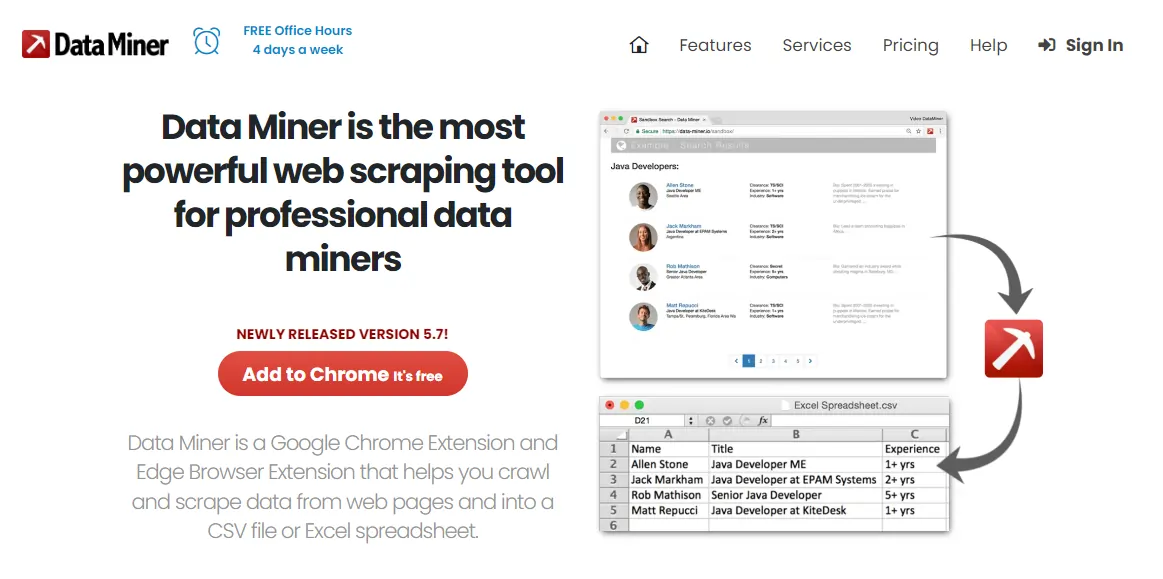
Data Miner is a powerful web scraping tool designed for professional data miners. It is a browser extension available for Google Chrome and Edge, which allows users to extract data from web pages and save it into a CSV file or Excel spreadsheet.
The tool is equipped with an intuitive user interface and a streamlined workflow, enabling users to execute advanced data extraction and web crawling with just a few clicks.
Data Miner can scrape single or multiple pages, automatically click on buttons and links, follow sub-pages, open pop-ups, and convert the scraped data into a clean CSV or Microsoft Excel file format.
It comes with over 60,000 pre-made data extraction rules and also allows users to create their own customized extraction rules.
The tool is secure and behaves as if a user were clicking on the page themselves, ensuring that users will not get blocked.
Data Miner Pricing
Data Miner offers a free plan that allows you to scrape 500 pages per month. The paid plans start at $19.99 per month for the Solo plan (500 pages/month), $49 per month for the Small Business plan (1,000 pages/month), and $99 per month for the Business plan (4,000 pages/month).
Pros of using Data Miner:
Cons of using Data Miner:
4. Bright Data
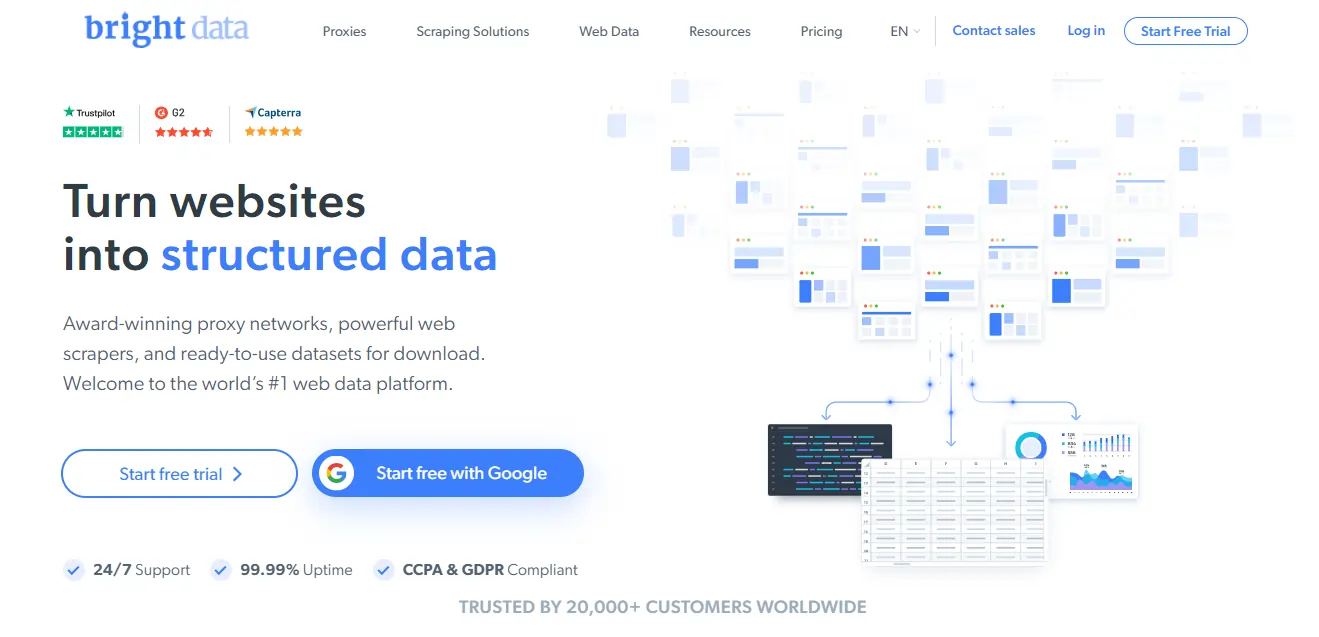
Bright Data, formerly known as Luminati, is a leading web data platform that provides a comprehensive suite of tools for web scraping and proxy services.
It is renowned for its robust proxy networks, which include residential, datacenter, ISP, and mobile proxies, enabling users to collect data efficiently and at scale.
Bright Data’s platform is equipped with advanced features such as automatic IP rotation, proxy manager, and web unlocker, which help users overcome website blocks and gather data seamlessly.
The platform is trusted by over 20,000 customers worldwide, including Fortune 500 companies, and is known for its high compliance standards, ensuring ethical use of its services.
With a focus on providing stable and reliable connections, Bright Data boasts a 99.99% network uptime and offers 24/7 customer support to assist users in maximizing the value of their data collection efforts.
Bright Data Pricing
Bright Data offers a Pay-As-You-Go plan with no commitment required, and pricing for residential proxies starts at $13.50/GB.
Pros of using Bright Data:
Cons of using Bright Data:
5. ScrapingBee
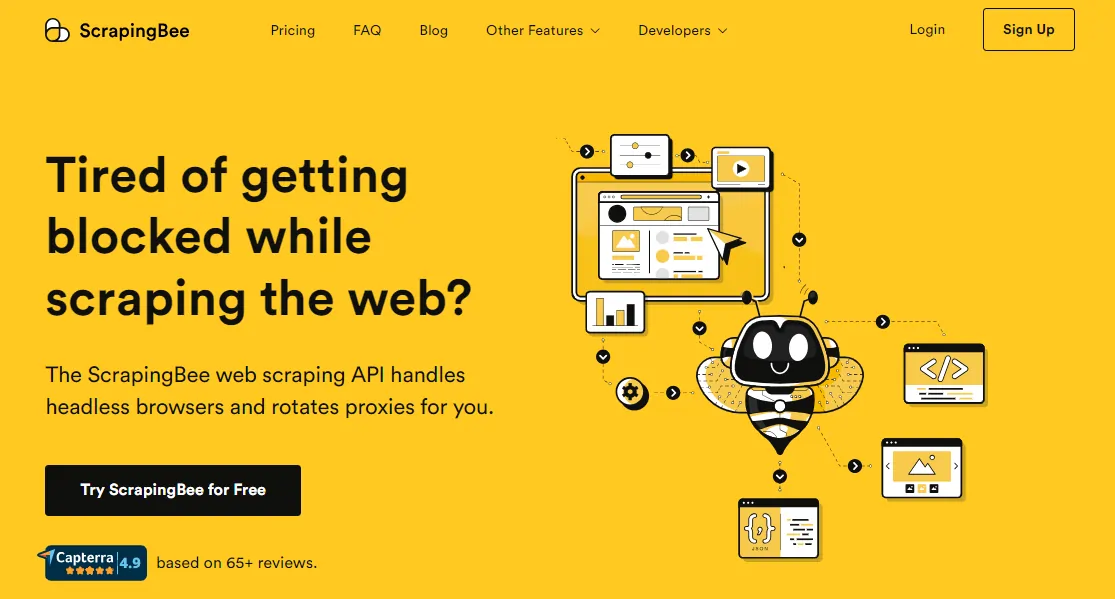
ScrapingBee is a web scraping API built to simplify the process of extracting data from websites. It handles proxies and headless browsers, allowing users to focus solely on data extraction.
The API supports JavaScript rendering, making it suitable for scraping single-page applications.
It offers a variety of features including data extraction with CSS or XPath selectors, JavaScript scenarios for actions like clicking and scrolling, and a large proxy pool to bypass rate limiting.
ScrapingBee also provides an HTML API that allows users to request data from websites, handle proxy management, and overcome common web scraping challenges.
It is designed to make web scraping more accessible and efficient for businesses, researchers, and developers, eliminating the need for managing complex infrastructure and proxies.
ScrapingBee Pricing
ScrapingBee offers several pricing plans: the Freelance plan at $49 per month for 150,000 credits, the Startup plan at $99 per month for 1,000,000 credits, the Business plan at $249 per month for 3,000,000 credits, and the Business+ plan starting at $599 per month for 8,000,000+ credits.
Pros of using ScrapingBee:
Cons of using ScrapingBee:
6. Scrapy
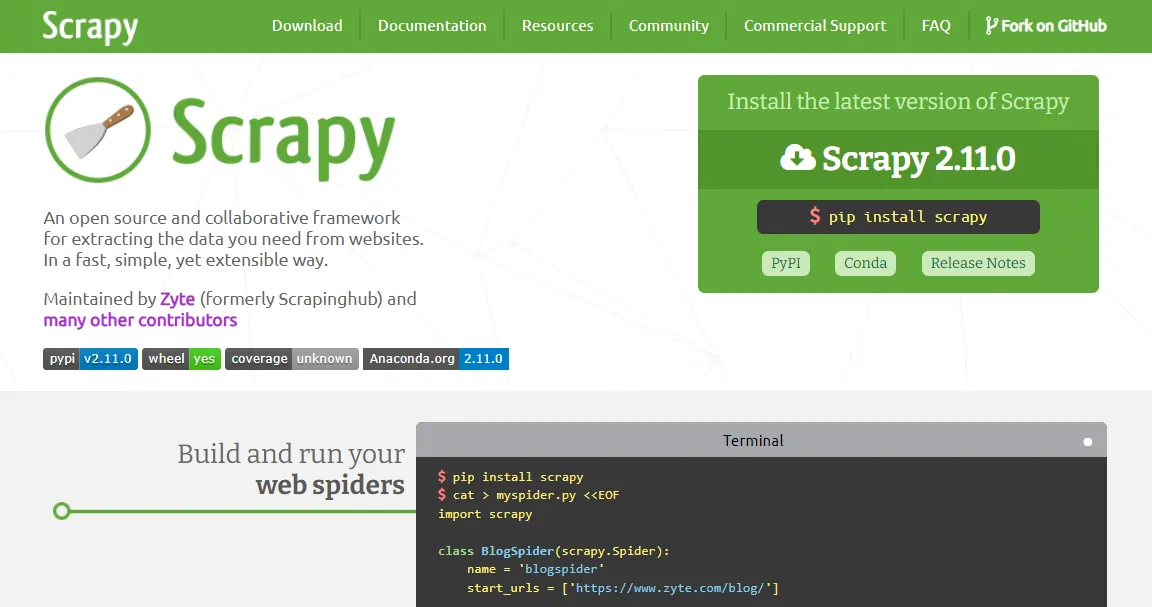
Scrapy is an open-source web crawling and scraping framework written in Python. It is designed to handle large-scale data extraction, making it ideal for data mining, information processing, and historical archival.
Scrapy is known for its high-speed crawling and scraping capabilities, allowing it to swiftly extract vast amounts of information.
It natively integrates functions for extracting data from HTML or XML sources using CSS and XPath expressions.
Scrapy is also extensible by design, allowing users to easily plug in new functionality without having to modify the core system.
It supports feed exports in formats such as JSON, CSV, and XML. Scrapy also offers a built-in mechanism called Selectors for extracting data from websites, and it handles requests asynchronously, making it fast and efficient.
Scrapy Pricing
Scrapy itself is free to use, but for cloud-based services, Scrapy Cloud’s Professional plan starts at $9 per Scrapy Unit per month (1 Scrapy Unit = 1 GB of RAM * 1 concurrent crawl).
Pros of using Scrapy:
Cons of using Scrapy:
7. ScrapeHero
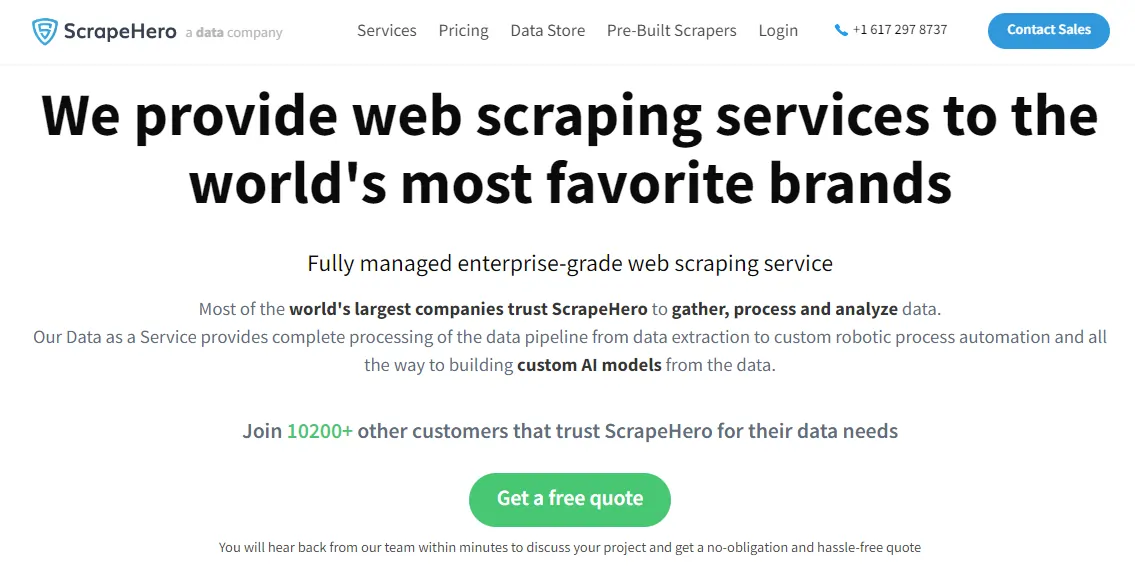
ScrapeHero is a fully-featured data extraction software made to fulfill the needs of startups and SMEs. It provides end-to-end solutions for web applications, offering a range of powerful features that set it apart from its competitors.
These features include image extraction, disparate data collection, document extraction, email address extraction, phone number extraction, pricing extraction, web data extraction, and IP address extraction.
ScrapeHero is a fully managed enterprise-grade web scraping service that transforms billions of web pages into structured data.
It employs AI and machine learning for data quality checks and offers robust data integration capabilities.
The platform is designed with a user-first approach, focusing on a point-and-click mechanism, making it easy for users to define what data they need.
ScrapeHero Pricing
ScrapeHero offers several pricing plans: the On-Demand plan starts at $550 per website per refresh, the Business plan starts at $199 per month per website, the Enterprise Basic plan starts at $1500 per month, and the Enterprise Premium plan starts at $8000 per month.
Pros of using ScrapeHero:
Cons of using ScrapeHero:
8. ScraperAPI
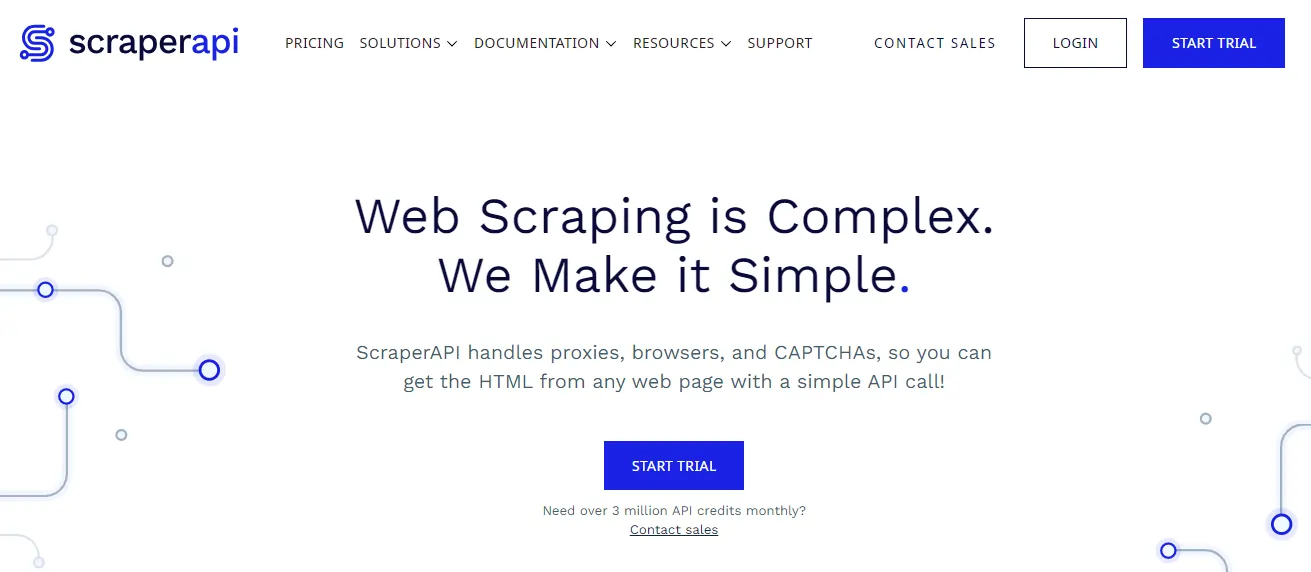
ScraperAPI is a robust tool that simplifies the process of web scraping for developers. It handles complexities such as proxy rotation, browsers, and CAPTCHAs, allowing developers to scrape any page with a single API call.
The API is built with developers in mind, offering easy integration and customization. It provides solutions for anti-bot detection and bypassing, ensuring that users never have to worry about being blocked.
With a guarantee of unlimited bandwidth and automatic pruning of slow proxies, ScraperAPI is ideal for fast web crawling.
It is scalable, capable of handling anything from 100 to 100 million pages per month.
The API also offers extensive documentation and SDKs, making it easy for developers to understand and use. It is GDPR and CCPA-compliant, ensuring data privacy and security.
ScraperAPI Pricing
ScraperAPI offers several pricing plans starting from $49 per month, with the option of a custom plan based on the customer’s request.
Pros of using ScraperAPI:
Cons of using ScraperAPI:
9. Oxylabs Scraper API
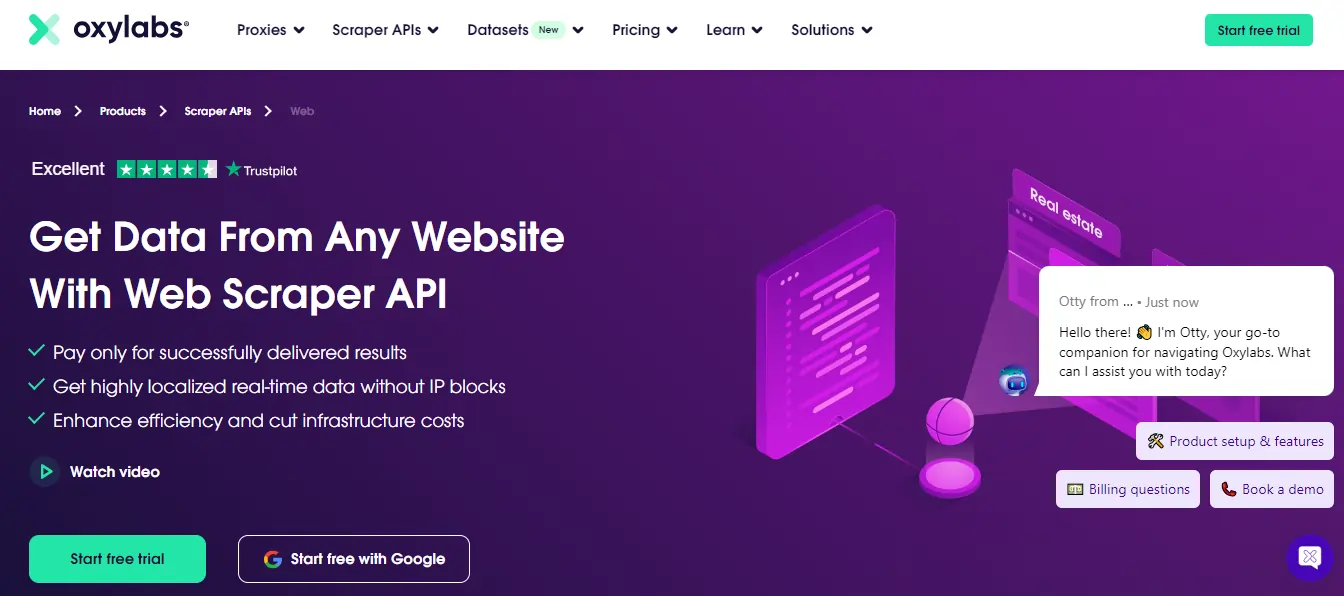
Oxylabs Scraper API is another top web scraping tool meticulously built for efficient and large-scale data extraction from a wide range of websites. It leverages an extensive proxy pool of over 102 million IPs, ensuring high success rates and fast data retrieval.
The API is designed to handle complex targets, including JavaScript-heavy websites, and offers easy integration with user systems. It eliminates the need for users to manage proxies, allowing them to focus on data collection.
The API supports high volumes of requests and delivers raw data from any data point of the user’s preferred target.
It also allows users to send custom headers and cookies at no extra cost for enhanced control over the scraping process.
Impressively, Oxylabs Scraper API is trusted by Fortune 500 clients as their main data provider.
Oxylabs Scraper API Pricing
Oxylabs Scraper API offers several pricing plans: Micro plan at $49 per month for 17,500 results ($2.80 per 1K results), Starter plan at $99 per month for 38,000 results ($2.60 per 1K results), and Advanced plan at $249 per month for 104,000 results ($2.40 per 1K results).
Pros of using Oxylabs Scraper API:
Cons of using Oxylabs Scraper API:
10. ParseHub

ParseHub is a sophisticated web scraping tool that empowers users to convert websites into structured data without any programming knowledge. It stands out with its intuitive point-and-click interface, allowing users to easily select and extract data.
ParseHub is capable of navigating complex websites, including those with dynamic content and interactive elements, and can automate data extraction from any site.
It supports a variety of features such as IP rotation, handling pagination, and exporting data in multiple formats like CSV, Excel, and Google Sheets.
Additionally, ParseHub can schedule scraping tasks and even bypass CAPTCHA challenges, making it a versatile choice for users ranging from software developers to business analysts.
ParseHub Pricing
ParseHub offers a free plan with basic features, while paid plans start at $189 per month for the Standard plan.
Pros of using ParseHub:
Cons of using ParseHub:
11. Websraper.io

WebScraper.io, one of the best web scraping tools that operates as a browser extension, making it easy to install and use directly from your browser. It can handle a wide range of data extraction tasks, from simple data scraping to complex data structure crawling.
WebScraper.io has a user-friendly interface that enables users to easily select and extract data without the requirement of coding.
It can navigate through multiple pages, follow links, and extract data from dynamic websites, including those that use AJAX and JavaScript.
The tool also supports data export in CSV format and offers cloud-based scraping, which allows for continuous data extraction without the need for a local machine.
WebScraper.io Pricing
WebScraper.io offers a free tier with basic features, and paid plans start at $50 per month for the Cloud Scraper plan.
Pros of using WebScraper.io:
Cons of using WebScraper.io:
12. Scrapingdog
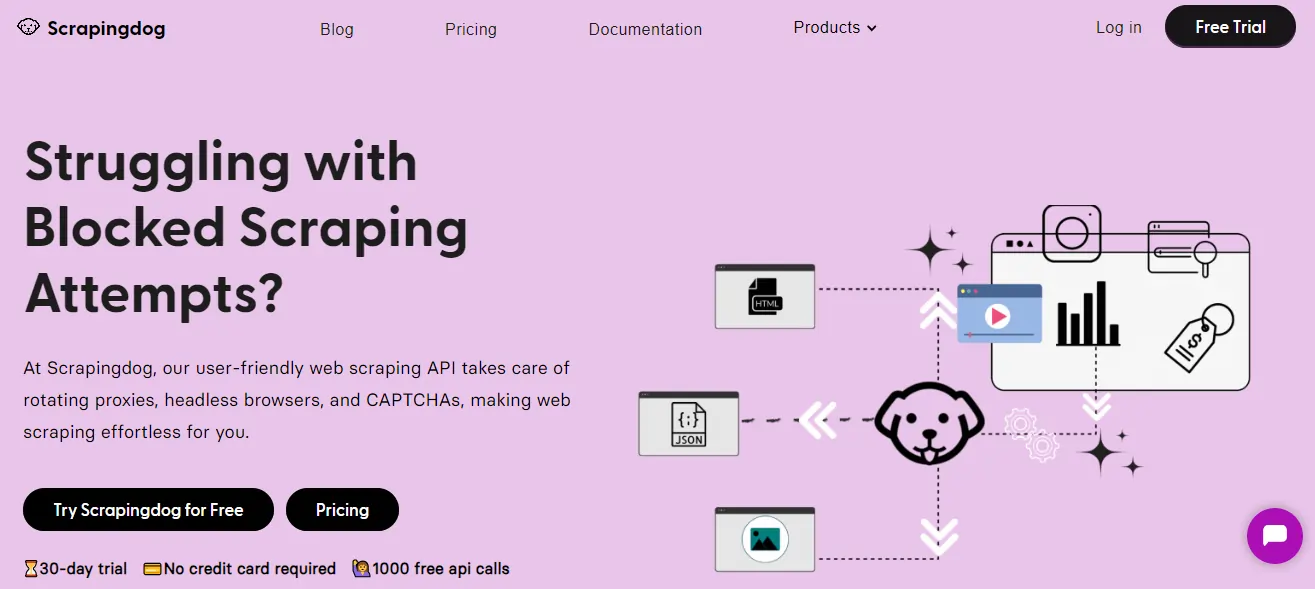
Scrapingdog is an enterprise-grade web scraping API that leverages a cluster of proxies and browsers to provide high-quality data extraction that circumvents bot mitigation systems.
The API is created to handle large volumes of simultaneous requests, ensuring quick and efficient data extraction. It uses multiple instances of headless browsers to scrape any website, even those that render data using JavaScript.
Scrapingdog’s infrastructure is backed by millions of rotating proxies and headless chrome, which increases the success rate of requests and prevents blockages.
The API also provides structured JSON data from Google search results and Amazon and LinkedIn profiles. With a pool of over 40 million proxies, Scrapingdog ensures that users bypass rate limits every time they scrape a platform.
Scrapingdog Pricing
Scrapingdog offers several pricing plans starting from $30/month for the Lite plan, the Standard plan costs $90/month, the Pro plan is $200/month, and the Enterprise plan starts at $500/month. Custom plans are also available upon request.
Pros of using Scrapingdog:
Cons of using Scrapingdog:
13. Import.io

Import.io focuses on empowering non-technical users to extract web data through an intuitive visual interface with AI-assisted modeling of data pipelines. It has an easy-to-use interface for extracting data from websites and turning it into structured data sets.
Import.io is equipped with advanced features such as authenticated extraction, interactive extraction, and the ability to download images and files.
It supports output in CSV, Excel, and JSON formats, and offers API access and webhooks for seamless integration with other applications.
Import.io also provides dedicated support through email, ticket, chat, and phone, ensuring users can get the help they need when they need it.
Import.io Pricing
Import.io offers several pricing plans: the Starter plan at $399 per month, the Standard plan at $599 per month, the Advanced plan at $1099 per month, and a Custom plan for tailored web scraping services.
Pros of using Import.io:
Cons of using Import.io:
14. Diffbot
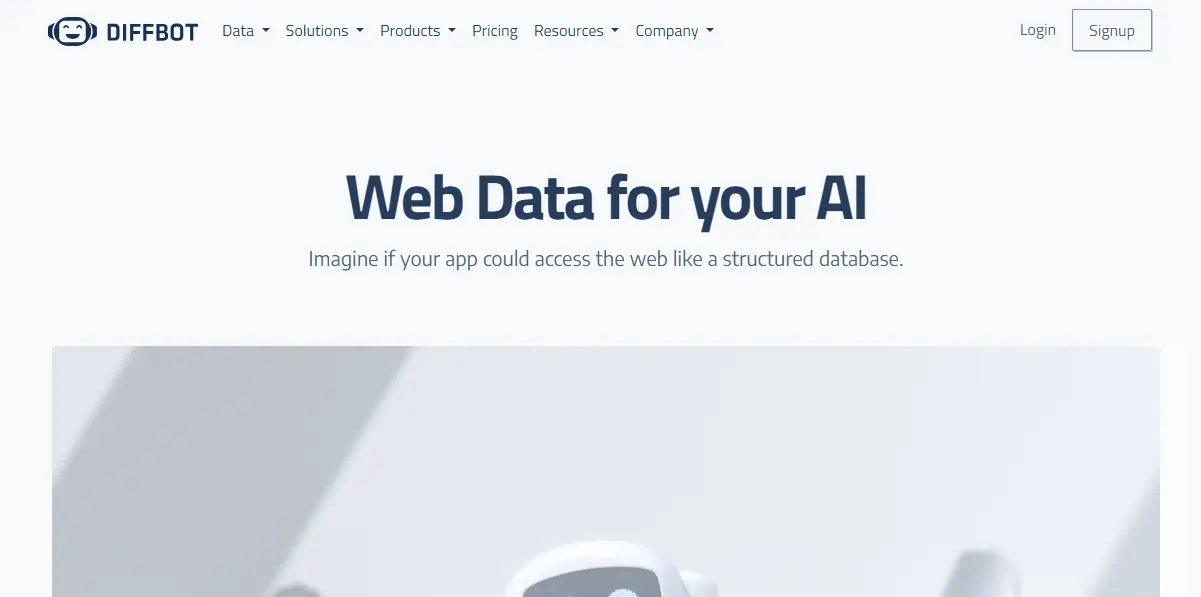
Last on the list is Diffbot, a state-of-the-art AI-driven web data extraction and crawling platform that leverages machine learning and natural language processing to transform unstructured data from across the web into structured, contextual databases.
It offers a suite of products crafted to enhance the way organizations access and utilize online data.
Diffbot’s key features include the ability to extract data from web pages, form a knowledge base, and the creation of knowledge graphs that provide a semantic understanding of the data.
It also offers an API for developers to integrate its services into their applications.
The platform is used by a wide range of customers, including freelancers, small businesses, mid-size businesses, and large enterprises.
Diffbot Pricing
Diffbot offers pricing plans starting from $299.00 per month, with a free trial available.
Pros of using Diffbot:
Cons of using Diffbot:
Forget Manual Scraping, It’s Time to Unleash the AI Data Kraken!
Imagine scooping up valuable data from the web, not with a rusty spoon, but with a giant, AI-powered Kraken! That’s what web scraping has become in 2024, and it’s about to revolutionize your business.
Gone are the days of struggling with rigid templates and outdated data. AI web scrapers have superpowers:
- Adaptability: Websites change like chameleons, but AI scrapers adjust on the fly, thanks to machine learning. No more broken scripts or wasted time!
- Accuracy: Tired of unreliable data? AI’s eagle eyes can read even the trickiest formats, from images and videos to complex text. Precision is their middle name.
- Speed: Need data yesterday? AI scrapers work overtime, pulling in massive amounts of information at lightning speed. Efficiency is their game.
But wait, there’s more! These AI Krakens can:
- Crack CAPTCHAs like codes: No more robot checks slowing you down. AI recognizes images like a human, bypassing these pesky roadblocks.
- Dive into unstructured data: Websites are messy, but AI can handle it. They understand context and meaning, extracting the gems hidden within.
- Predict the future (almost): With advanced algorithms, AI can even anticipate website changes and data trends, keeping you ahead of the curve.
Ready to unleash the Kraken on your data needs? Here’s how:
- Find your perfect match: From market research to price monitoring, different AI scrapers specialize in different tasks. Choose the one that fits your mission.
- Respect the rules: Remember, data has owners. Scrape ethically and legally, following website terms and avoiding privacy violations.
- Embrace the future: AI web scraping is still evolving, but its potential is vast. Stay curious and explore its possibilities to unlock new opportunities.
The bottom line? AI web scraping is a game-changer. It’s faster, more accurate, and way cooler than manual methods. So, ditch the spoon and dive into the AI data ocean – there’s a treasure trove waiting to be discovered!
P.S. Don’t worry, AI isn’t replacing humans – it’s empowering them. Focus on the strategic stuff, while your AI Kraken handles the data heavy lifting. Now go forth and conquer the web!
FAQs:
- What are some top AI scrapers? Check out Scrapper API, Webscraper.io, AnyPicker, and Bardeen.ai.
- Is it legal? As long as you follow website terms and respect privacy, you’re good to go.
- What can I scrape? From market trends to competitor pricing, the possibilities are endless. Just be ethical!
Remember, the future of data is intelligent. Are you ready to join the data revolution?