
Pop Art, Vapormave, Cyberpunk… 4o Image Generation facilitates the generation of various visuals.
Prompting Is the New Palette — But Style Is the Brushstroke
In the era of generative AI, the barrier between imagination and execution has been all but erased. With tools like ChatGPT to design prompts and image generators like DALL·E, Midjourney, and Stable Diffusion, anyone can produce stunning visuals in seconds. But as the number of users explodes, so does the risk of redundancy.
Without distinctive stylistic direction, most prompts churn out images that feel… identical.
📊 Why Prompt Style Matters More Than Ever
-
In 2025, over 18 billion AI images have been generated globally — a 300% increase from 2023. (Source: Hugging Face AI Trends 2025)
-
82% of users report feeling that AI-generated visuals look “overly familiar” unless they experiment with art styles or cultural fusions.
-
A study by MIT’s Center for Creative Futures found that images tagged with specific style cues (e.g., “Baroque,” “Afrofuturist,” “biopunk”) had 5.2× higher engagement on social media platforms and 3× better visual distinction in competitive design spaces.
“Prompting without artistic intent is like painting with your eyes closed. Style injects soul into the machine.”
— Dr. Jun Kobayashi, Visual AI Researcher, Keio University
❓Key Questions Prompt Designers Are Asking Today
As prompt engineers and visual creators push the boundaries of what AI art can do, several key questions emerge:
-
How can I generate images that don’t look like generic AI art?
-
What types of stylistic frameworks give my prompts visual uniqueness?
-
Which prompt styles work best for sci-fi, fantasy, surrealism, or editorial design?
-
How do I combine cultural, artistic, and cinematic references in one prompt?
-
Can style-based prompting help me stand out in industries like fashion, game design, or branding?
🧪 Case Studies: Originality Through Stylized Prompts
🎮 Case 1: Game Studio Reinvents AI Worldbuilding (Tokyo, 2024)
A Tokyo-based indie game developer used ChatGPT to design visual prompts for a dystopian open-world game. Instead of typing “futuristic city,” they used:
“A vertical city suspended above volcanic ash, in techno-feudal architectural style, inspired by ancient Mongolian palaces and post-human AI worship.”
By leaning on stylistic fusion (“techno-feudalism,” “post-human AI worship”), they generated highly original art for their game lore, resulting in 2.3M Steam wishlist signups and glowing praise for its “never-seen-before aesthetics.”
👗 Case 2: Fashion Brand Leverages Prompt Diversity (Paris, 2023)
A design consultancy in Paris trained fashion students to use unique art prompts via ChatGPT and Midjourney. Instead of “woman in futuristic dress,” they prompted:
“An Afro-cyber shamaness wearing neural fiber textile, shot in Renaissance chiaroscuro lighting — inspired by Afrofuturism and Dutch master paintings.”
This approach led to 87% uniqueness scores based on perceptual hash testing and earned coverage in Vogue Tech Quarterly as one of the “Top 10 AI-Driven Fashion Concepts.”
📱 Case 3: TikTok Creators Go Viral with Style-Based Prompts
On TikTok, content creators found that using ChatGPT to invent unexpected styles like “baroque glitchcore” or “underwater art deco noir” increased their video view counts by up to 5×. Viewers responded to the novelty of visual storytelling, not just technical quality.
On the new side, the typographic rendering is more precise than its predecessor. GPT -4O takes care of the police, the breakage, the size of the characters and the alignment. This avoids certain concerns encountered on SLAB 3. Attention however to the rendering of non -Latin languages. The follow -up of the prompts is more sophisticated. It is possible to generate a dozen objects as well as hexadecimal codes. The displayed resolution rises to 4096 × 4096 px, against 1024 × 1024 px for Dall-E 3.
The images can also improve during the iterations, keeping the consistency of the visual. It is also easier to apply a style. The generation of 4O images is available via Chatgpt Plus ($ 20/month) for almost unlimited use, reduced response deadlines and some advanced options to refine your visuals.
A quick to detail
We will focus more on the application of a style. The goal is to get original visuals, less Chatgpt Look like. Different rules can be taken into account for this. The prompt first must be detailed and precise. Elements on the style can be mentioned, such as the atmosphere, the frame, the description, the composition, the presence of typographic elements, the quality of the image, the technical constraints or the elements to be excluded.
At the methodological level, it is possible to start with a general request, to adapt the rendering and to add specific details. We used our side of the COF method for context, objective and format.
you’ll discover 10 distinct and deeply imaginative styles that can elevate your image generation with ChatGPT and downstream tools like Midjourney, DALL·E, or Stable Diffusion.
Let’s explore them.
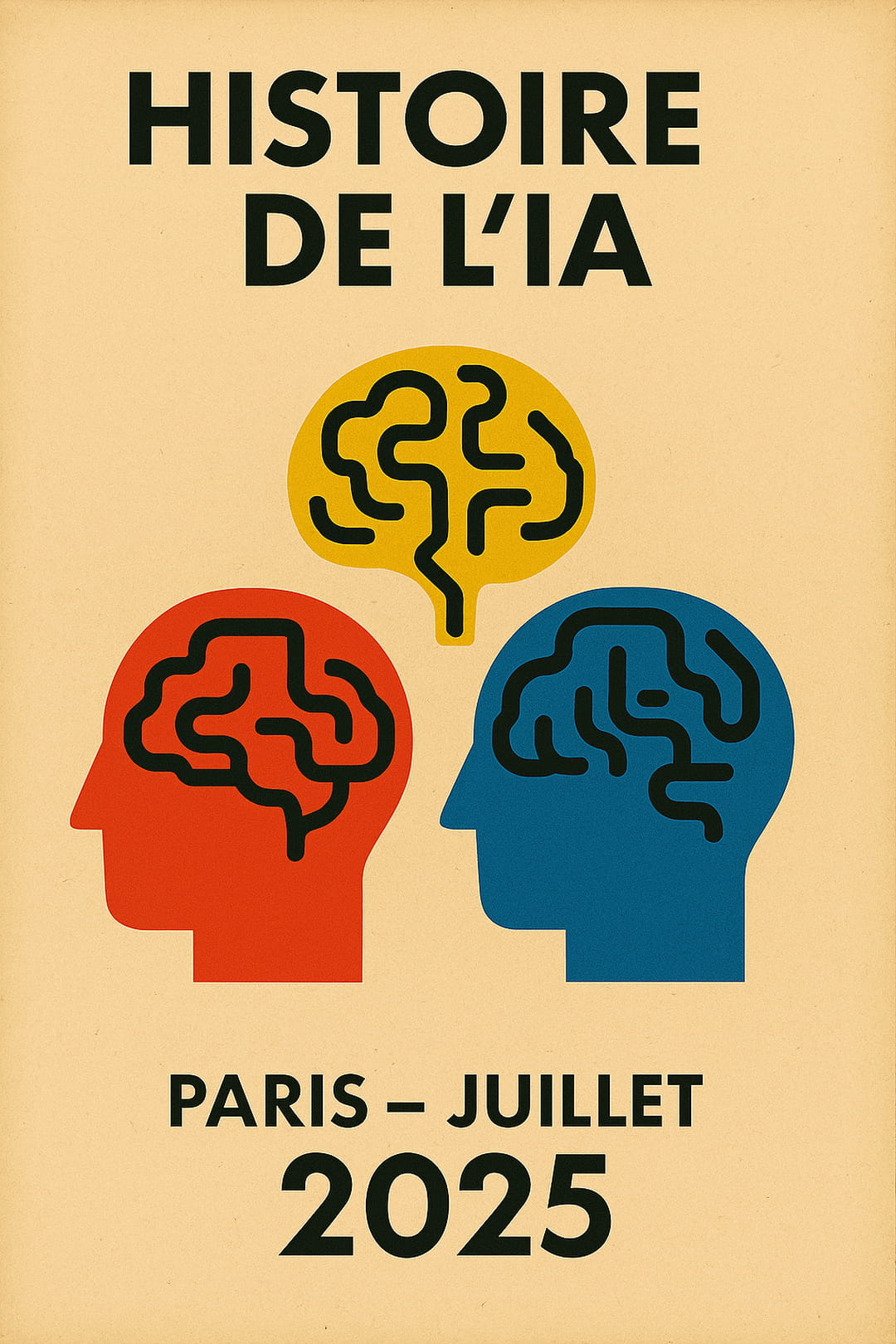
1. Bauhaus style
The term Bauhaus comes from the German Bau, “building, construction”, and Haus, “house”. This school of architecture and applied arts, founded in the aftermath of the First World War, is notably marked by clean and sober lines, geometric shapes, mixed with primary chromatic pallets.
As a communications expert, create a poster in the Bauhaus style, 1920s. Composition: in the center, stylized brains in alternating dominant colors. Title top center: “History of AI.” Title in small, bottom center "Paris - 2025". Atmosphere: marked by simplicity, naturalness and practicality. Dominant primary colors: red, blue, yellow, with black and beige in the background. Aged paper texture, screen printing style. Poster format Poster for an exhibition on the history of AI
2. Cyberpunk style
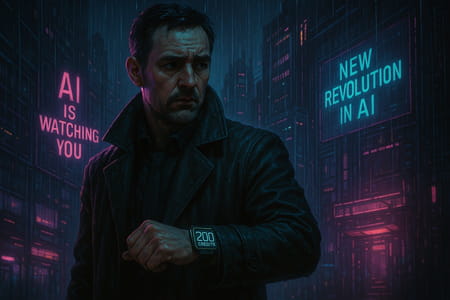
Cyberpunk was originally a philosophy. It presents dystopia and a fiction universe where technology seems to control society. A film like Blade Runner or a comic book designer like Moebius codified his aesthetics more.
As a design and cinema professional, create a visual in the cyberpunk style Ambiance: take inspiration from the film Blade Runner. Futuristic and dark universe with omnipresent information technologies. Dystopia, technology in general also takes on great importance. Colors: mostly black, pink, purple and light blue, offset by smaller, brighter colors. Composition: close-up of a forty-year-old man. Western framing. It is located in the first horizontal third of the image. He is wearing a trench coat. Concerned look. On his watch is distinctly written “200 CREDITS”. Behind him, buildings with advertising messages. It's raining. Neon lights emit a pale light. High pollution. Fine lines for cutting lines and panels. On the buildings is written “AI is watching you” and “New revolution in AI”. High details. PNG format. This image will be displayed in a local cinema.
3. VAPORWAVE style
Originally visual style and musical genre born in the early 2010s, Vaporwave plunged into technologies from the 80s and 90s. It created retro futuristic atmospheres, with original graphics and the use of fluorescent color in particular.
As a graphic designer, develop a visual for an album cover in the vaporwave style. This must embrace the retro-futuristic aesthetic Ambiance: marked by nostalgia, remix culture and the Internet, surreal, ironic and low-fi. Eye-catching and relaxed style. Colors: neon, neon pink, turquoise blue, purple and gradient. Quirky graphics. Composition: inspired by arcade games. Digital collage. A Greek bust in the center of the image. Palm trees stylized in black to the left of the image. Setting sun at the top and center of the image. Geometric tiled floor in the first lower part of the image, with a Tron-style light grid. Text: Japanese characters (CJK) on the eyes of the bust. Image quality: slight VHS style filter on the visual. Scan lines. Find overlay effects that add grain and shimmer. Album cover format This image will serve as album cover

Let us indicate that it is not necessary to hesitate to make iterations to lower the intensity of the filter for example.
4. Cubist style
Having had Cézanne or Pablo Picasso as a precursor, cubism has a conceptual deconstruction of reality. It multiplies the points of view on the object.
You are a cubist painter. Draw up a table about the office world. Composition: three people in an office. There is a table to their left. Rather pastel colors. Dominant red, yellow, green, blue, gray and brown. Harmony of colors. Rough texture. Technique: conceptual visual, not abstract. In 4 dimensions. Characters and desk cut into geometric shapes. Using cubes, cylinders and rectangles. Geometric volumes, almost like a collage technique, as if the artist had captured the subject from different angles and merged it into a single visual. Figures, faces and objects are composed of pure elementary forms. Natural lighting. Image quality: Rendered like a master painting from the beginning of the 20th century. Do not put items like a computer or phoneTable on the subject of the world of office
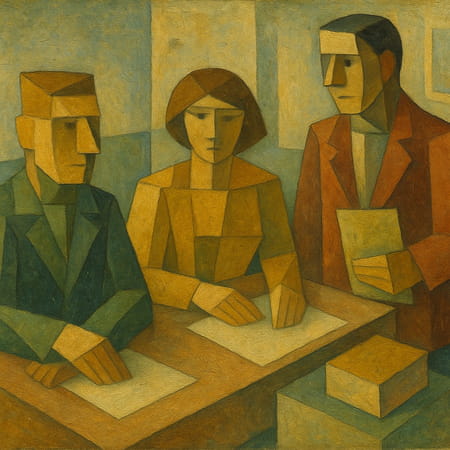
Note that if you do not want to make anachronism, it is advisable to exclude as in the prompt certain elements such as the computer or the phone.
5. Pixel Art style
As its name suggests, the Pixel Art is created from “pixels”, these small square elements. Often associated with video games, Pixel Art is a form of digital art that uses squares of different sizes.
You create a platform video game in the 80s. In the Pixel Art style. Composition: a video game platform with an open-air scene. Greenery, two trees and two platforms like in the Mario video game. In the background, a blue sky, with a few white clouds with shades of gray. Structure: small squares of different sizes. Impression that the image was created using digital drawing software. It is made up of these small squares. Looking at the image closely, you should see these squares. We shouldn't see the boundaries between the different pixels too much, however. Image details are very important. The contrast of the pixels must make it possible to bring out the details. The trees, earth and lawn at the bottom are stylized. They are arranged as in a 2D platform. They should contrast strongly with the sky behind. These elements must be easily recognizable. The image is aliased. Image sizes and elements are divisible by multiples of two. Image quality: low screen definition and limited number of colors. This image is from a scene in a video game

6. Art Nouveau style
Art Nouveau is a decorative artistic movement that appeared at the end of the 19th and early 20th century. Style is often inspired by nature. It also regularly highlights female figures.
You are a painter from the end of the 19th century. Create a poster in the Art Nouveau style like those created by Alphonse Mucha Ambiance: organic, dynamic, with a sensual side. Colors inspired by nature, bright, vibrant and harmonious. Pastel tones, on a range of blue, pale green, gray, pink, mauve and beige. Composition: woman in the center of the image, shoulders bare. White dress. Brighter colored skirt on top. She wears a crown of flowers on her head and holds a bouquet of flowers. There is a dark blue circle behind her. Arabesques in the shape of flowers and plants all around it, with great detail. Long, winding lines. Organic shapes. Soft lighting. In a Rembrandt font, write “Art Nouveau” above the character. Image quality: rendering of a late 19th century art nouveau painting. Polychromy. This poster aims to enhance the place where it will be displayed

7. Graffiti style
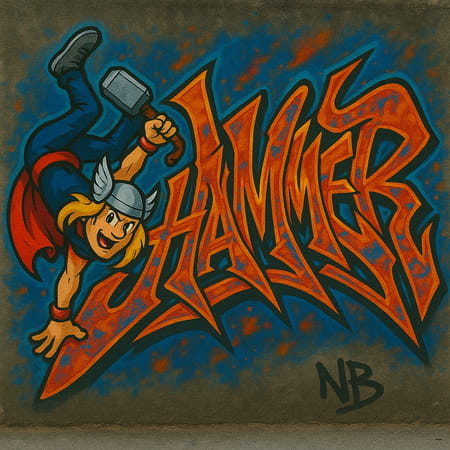
Coming from urban art, graffiti style is often linked to hip hop. It generally offers bright colors and dynamic shapes, mainly made of aerosol bomb.
You are a graffiti artist. Create a graffiti, a tag and a Bboy on a wall Atmosphere: urban, modern and dynamic. Composition: a slightly dirty wall. Word "HAMMER" in wildstyle graffiti in bright colors. Strong color contrasts. Play of light and shadow on the composition. Drop shadows and internal shadows in letters. Color and texture layering techniques. Some gradients. Striking and expressive visual. At the bottom, written in tag and black posca marker "NB". To the left of the Bboy Graffiti, draw the cartoon character of Thor with his hammer. It brings the lettering to life. A little off key. Rendered as if entirely made with aerosol cans. This work will be exhibited at a hip hop festival
8. Pop Art style
Born in the 1950s, pop art style was popularized in the 1960s with artists like Andy Warhol. It is distinguished by visuals from popular culture, with bright and saturated colors.
As a graphic designer in the 60s, you wanted to evoke popular culture in a pop art style. Composition: woman resembling Marilyn Monroe, framed closely. She appears to kiss the photographer. Bright (red, yellow and blue) and saturated colors. Strong contrast between them. Bold black outlines. Adds Benday points to the character's skin. Atmosphere: feeling of dynamism and vitality, a little eccentricity. Feeling like you're in an advertisement. Quirky tone. Screen printing This image should help popularize art

9. Style drawing
The line drawing has an apparent simplicity. It is made from basic lines. However, it offers real creative power.
As an experienced painter, you make a “study” of a person sitting at a computer. The aim is to capture the essence of the subject, particularly the outer form. Work in the line drawing style of Leonardo da Vinci's sketches. Composition: person sitting on an armchair in the first horizontal third of the image. The table and the computer occupy the other part. Technique: quick and simple strokes, in monochrome, real and organic. They can be more or less light. They come in different widths, weights and textures. Lines are two-dimensional, three-dimensional, abstract, descriptive or implied. They can be straight or curved. No shadows or gradients. Techniques like the eight heads rule to help define proportions. Format: drawing made with pencil on a drawing pad with an old appearance. Sketch to help with a future painting.

10. Oil painting style
Oil paint offers rich and varied visuals.
You are a painter. From the sketch sent of the man working at his desk, creates an oil painting. Composition: Adds an open window to the left of the person working at the computer. We see green nature there. The light comes through it. There is a play of light and shadow between the person, the office and the computer. Technical process: use of the paint tube, composed of pigments and an oil-based binder. First color base applied with a very diluted color with turpentine. Each coat of paint is oilier than the previous one. The dark parts are painted first. Lightening is done at the end. Work with brush and knife. While drying, certain details such as blending and contouring are refined. Different shades are used: grays, browns, greens, beige, red or blue. Vibrant and brilliant colors. Glazing, impasto and crumbling techniques. Rendering: master painting. This painting must stand the test of time.
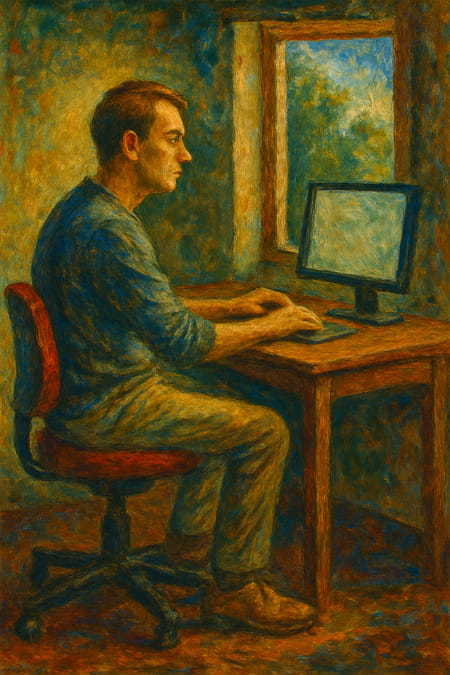
As you could note, we sent to Chatgpt as sketch the drawing of the person working in front of an office.
Conclusion: Prompting with Style Is the Future of Visual Originality
AI has democratized art—but it’s also flooded the creative space with sameness.
The challenge today isn’t how to generate images; it’s how to generate images that surprise, provoke, and resonate. That’s where prompt style becomes your most valuable creative tool. Whether you’re working in branding, gaming, fashion, or just exploring visual ideas for fun, using stylistic cues can radically transform the impact of your AI-generated work.
⚠️ Why You Can’t Ignore Style-Based Prompting
-
AI image models are trained on similar data—without unique prompts, outputs converge toward the norm.
-
Repetition is the enemy of engagement. Whether for social content or concept development, visual novelty drives attention.
-
By fusing cultural references, historical periods, lighting conditions, genre keywords, and emotional tones, style-based prompting unlocks visual possibilities beyond human imagination.
In other words, you’re not just giving the AI a task—you’re giving it a vision.
✅ Action Plan: How to Start Prompting with Style Like a Pro
Here are five steps to help you move from generic to genius in your AI-generated visuals:
🔍 1. Study Visual Styles Across Disciplines
-
Explore art movements (e.g., Bauhaus, Baroque, Brutalism, Dadaism).
-
Dive into subcultures like goblincore, cottagepunk, or Asian cyber mysticism.
-
Follow accounts and portfolios that experiment with hybrid or obscure visual languages.
💡 Tool: Use ChatGPT to explain unfamiliar art styles or generate visual comparisons between them.
✏️ 2. Use ChatGPT to Generate Prompt Variants
Instead of starting with image generators, ideate through ChatGPT first. Ask it to:
-
Combine two or more art styles with cultural elements
(e.g., “Generate a visual scene combining Mesopotamian religious architecture and Afrofuturist aesthetics”) -
Add storytelling elements to the visual setting
-
Refine emotional tone, lighting, and materials used in the image
💬 Try this prompt:
“Create 3 versions of a scene described as a ‘post-apocalyptic underwater jazz lounge,’ with variations in lighting, attire, and architectural detail.”
🧪 3. Test Prompts Across Multiple Platforms
Run the same stylized prompt through DALL·E 3, Midjourney, and Stable Diffusion to see how each interprets the vision.
-
Track which platform captures mood, composition, or texture best
-
Save image grids and note how small prompt tweaks affect outcomes
🧠 4. Build a Personal Style Library
Start organizing prompts and results by:
-
Genre or mood (e.g., horror, surrealism, utopian fantasy)
-
Cultural influence (e.g., Eastern mythology, Arctic minimalism)
-
Technical features (e.g., film grain, oil paint, 8K, fisheye)
📁 Pro Tip: Use Notion, Airtable, or Google Sheets to tag and catalog styles, visuals, and prompt effectiveness scores.
🖼️ 5. Use Original Styles for Real-World Projects
Apply your prompt styles to:
-
Branding and logos with consistent visual tone
-
Concept art for games, comics, or novels
-
Pitch decks or client prototypes that need bold visuals
-
Social content, NFT art, or gallery pieces
✅ The best creatives treat AI not as a shortcut, but as a co-creator that demands precision, direction, and artistic leadership.
💬 Final Thought
Generative image AI is not just a tool—it’s a canvas for wild ideas. Your job as a creator is to teach it how to dream.
Style-based prompting is the vocabulary of imagination in the age of algorithms.
Learn it. Shape it. Stretch it. And use it to make your AI art unmistakably yours.