AI TOOLS 2024.

With the establishment of a new Accenture NVIDIA Business Group, Accenture and NVIDIA have strengthened their collaboration with the goal of assisting businesses in scaling the adoption of AI. As part of this program, 30,000 people will receive training throughout the world to help clients extend the usage of corporate AI systems and rethink processes.
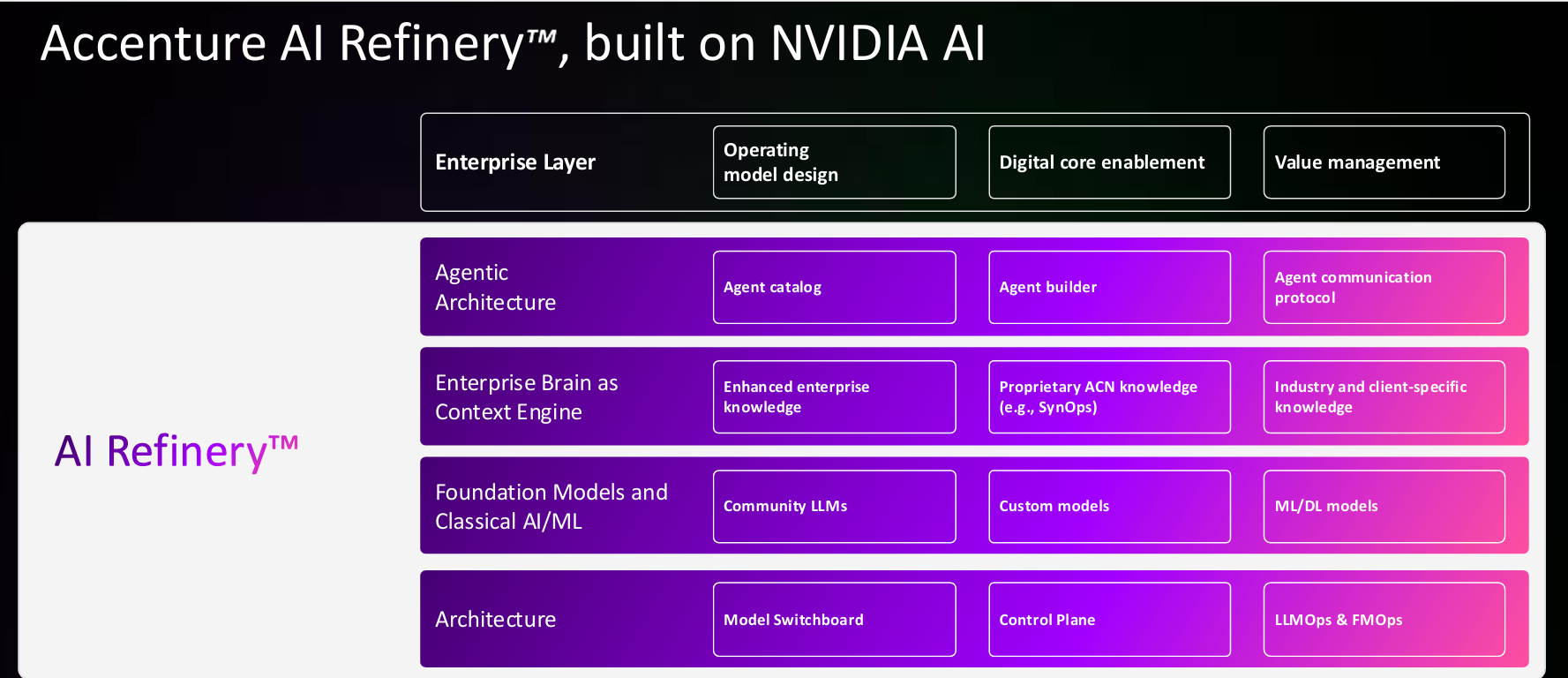
In order to assist businesses in expediting their AI journeys, the new business group will make use of Accenture’s AI Refinery platform, which makes use of NVIDIA’s AI stack. The AI Refinery intends to simplify AI-powered simulation, process redesign, and sovereign AI. It will be accessible on both public and private cloud platforms.
Scaling Agentic AI Systems
Accenture’s AI Refinery is set to scale the next frontier of AI : agentic AI. “We are breaking significant new ground with our partnership with NVIDIA and enabling our clients to be at the forefront of using generative AI as a catalyst for reinvention,” said Julie Sweet, chair and CEO of Accenture.
Accenture is launching a worldwide network of AI Refinery Engineering Hubs in strategic locations like Singapore, Tokyo, Malaga, and London to support this strategy. The large-scale development of AI operations and models will be the main emphasis of these hubs.
NVIDIA’s creator and CEO, Jensen Huang, continued, saying that artificial intelligence (AI) will enable businesses to scale innovation more quickly. Successful use examples of this partnership have already been observed, such as the employment of agentic AI by Indonesia’s Indosat Group to create financial services industry-specific solutions.
Accenture is also introducing the NVIDIA NIM Agent Blueprint, which integrates NVIDIA Omniverse and Isaac software, for virtual manufacturing simulations. Accenture’s marketing team has also started to optimize campaigns utilizing the AI Refinery platform with autonomous agents, resulting in a 25–55% faster time to market.
Accenture has been actively implementing generative AI across their platform by offering their staff members options for training and upskilling.
Agentic AI has been a prominent topic of conversation across major tech companies over the previous few weeks. Major Saas providers, like Oracle and Salesforce, have released several AI agentic technologies in their extensive product range. Additionally, the number of clients receiving independent databases has been steadily rising.
Accenture also leverages Nvidia’s NIM (Neural Inference Microarchitecture) and NeMo offerings for better token efficiency and for fine tuning and evaluation, said Justin Boitano, vice president of enterprise AI software products at Nvidia.
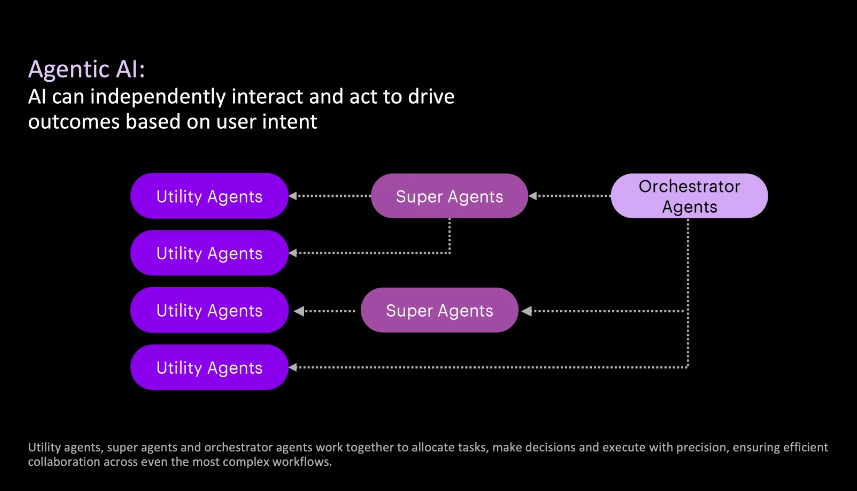
The next generation of agentic AI will be a major advancement, changing the way our clients reimagine their businesses. It goes beyond simply asking the large, prebuilt language models questions and then waiting for a response. We can actually create specialized cap that can freely and autonomously engage or act to advance against goals or human intention right now using agentic AI using what we refer to as “zero-shot prompting.” Our goal with AI is to have it not just respond but also learn, grow, and collaborate with others.
Accenture’s agentic AI is made up of three different kinds of “armies of agents.” There are utility agents that specialize in a single task – she utilized a research agent as an as an example – super agents that act as team leads activating utility agents, and orchestrator agents, project managers that orchestrate the various workflow functions across the enterprise.
The movement to make it easier for businesses to tailor AI systems to their needs—such as retrieval-augmented generation (RAG), which enables businesses to incorporate their own corporate data into the training set for AI models—and AI agents work together somewhat since ChatGPT was released nearly two years ago.
In addition to prebuilt agents, Accenture’s AI Refinery offers agent builders for constructing unique agents. Organizations also can construct their own AI models using their own data and it includes a “switchboard architecture to route between different models to pick the models that is aligned with your objectives without getting locked in.
As with nearly anything in generative AI, there also exist obstacles when it comes to AI agents, including such standbys as data security and privacy, potential bias, ethical issues, and blunders committed by the system. There will be a greater need for human supervision and intervention as AI systems become more independent.
However, that will need to be addressed because the generative AI train is already moving quickly and will only pick more speed as agentic AI joins the fray.
The development of technology has advanced to the point where agentic AI will fundamentally alter our understanding of productivity and innovation in the setting of scale AI. Agentic AI is going to be a key component of commercial and organizational innovation.