AI and Autonomous Vehicles (AVs)

AI plays a pivotal role in the development and deployment of autonomous vehicles (AVs), enabling real-time decision-making, navigation, safety features, and more. Below are key statistics and trends regarding AI’s impact on the autonomous vehicle industry:
1. Market Size and Growth:
- The global autonomous vehicle (AV) market was valued at $54 billion in 2022 and is expected to reach $2.16 trillion by 2030, growing at a CAGR of 40.1%.
- The market for AI in autonomous vehicles is projected to grow from $10 billion in 2021 to $90 billion by 2030, with AI being central to tasks like perception, decision-making, and control systems.
- By 2030, it is estimated that 12-15% of all new vehicles sold will be autonomous, largely powered by AI technologies.
2. Key AI Technologies in Autonomous Vehicles:
- Computer Vision: AI-based computer vision systems are used for real-time object detection, lane detection, and obstacle avoidance. More than 60% of autonomous vehicle systems incorporate deep learning for vision tasks.
- Sensor Fusion: Autonomous vehicles rely on AI-powered sensor fusion to integrate data from cameras, LIDAR, radar, and other sensors. This technology is expected to account for 35% of the AI in AV market by 2025.
- Machine Learning and Deep Learning: These technologies are used for decision-making processes, enabling AVs to learn from road data and improve over time. 80% of AV systems employ some form of machine learning for predictive maintenance, driving policy, or route optimization.
3. Autonomous Driving Levels:
- AI plays a critical role across different levels of vehicle automation:
- Level 2 (Partial Automation): As of 2023, 30% of new vehicles sold have Level 2 automation, which involves advanced driver-assistance systems (ADAS) like Tesla’s Autopilot, using AI for tasks such as lane centering and adaptive cruise control.
- Level 3 (Conditional Automation): 10% of vehicles in advanced markets (such as Japan and Germany) are equipped with Level 3 automation, allowing the vehicle to handle most driving tasks under certain conditions, relying heavily on AI decision-making.
- Level 4-5 (High/Full Automation): Fully autonomous vehicles (Levels 4 and 5) are expected to account for 3-5% of all vehicle sales by 2030, with AI being the central technology enabling driverless operation.
4. Major Players and Investments:
- Waymo (Google’s AV subsidiary) has logged over 20 million autonomous driving miles on public roads and more than 20 billion miles in simulation, utilizing AI for advanced perception and decision-making.
- Tesla‘s Full Self-Driving (FSD) technology, powered by AI, is used in over 500,000 vehicles, making it one of the most widely deployed AI systems in the AV space.
- GM’s Cruise: Backed by AI, Cruise has deployed fully autonomous vehicles in cities like San Francisco, having driven more than 3 million autonomous miles by 2023.
- Global AI investments in AVs surpassed $50 billion in 2022, with leading players like Baidu, NVIDIA, and Mobileye contributing significant research and development in the space.
5. AI-Driven Safety and Efficiency:
- AI-powered safety systems reduce the probability of accidents by up to 90%, helping AVs detect obstacles, pedestrians, and other vehicles with faster reaction times than human drivers.
- AI contributes to 10-15% fuel efficiency improvements in AVs by optimizing driving patterns, route planning, and vehicle performance.
- AVs can reduce traffic accidents caused by human error by 30-40% by 2030, as AI systems manage real-time decision-making and reduce fatigue-related accidents.
6. Autonomous Trucks and Delivery:
- AI in autonomous trucks is projected to grow by 25% annually, with the global autonomous trucking market expected to reach $1.7 billion by 2025. Companies like TuSimple and Aurora are leading the charge in AI-powered long-haul freight.
- Autonomous delivery vehicles (including drones and robots) are expected to grow at a CAGR of 45%, with AI powering navigation and safety systems. By 2030, 30% of last-mile deliveries could be handled by autonomous systems.
7. AI and AV Regulations:
- 45% of countries with advanced AV programs (like the U.S., China, and Germany) have implemented AI-related regulations to guide the development and safe deployment of autonomous vehicles.
- The U.S. National Highway Traffic Safety Administration (NHTSA) and similar global regulatory bodies are working to standardize AI-driven autonomous safety features, with 50% of countries expected to have comprehensive AV safety frameworks by 2025.
8. Public Perception and AI Trust:
- 58% of consumers globally are skeptical of fully autonomous vehicles due to concerns about safety and reliability, but confidence in AI-powered driver-assistance systems is growing, with 65% of users in favor of AI in ADAS (Advanced Driver Assistance Systems).
- Surveys show that 25% of consumers would be willing to purchase a fully autonomous vehicle within the next five years if AI-powered safety measures continue to improve.
9. Challenges for AI in AVs:
- Edge cases (unusual or rare driving situations) remain a significant challenge for AI in AVs, with 15% of disengagements during testing due to scenarios not well-understood by current AI systems.
- Weather and environment: AI systems in AVs can struggle with adverse weather conditions like snow or heavy rain, which reduces sensor accuracy. Current AI technologies address 70-80% of environmental challenges, with ongoing research improving robustness.
- The AI “black box” problem, where decision-making processes are not fully transparent, has led to 40% of regulators calling for increased transparency in AV systems’ AI algorithms.
10. Future Trends:
- AI-driven vehicle-to-everything (V2X) communication will play a major role in autonomous driving ecosystems, allowing vehicles to communicate with other cars, infrastructure, and pedestrians to improve safety and efficiency.
- By 2035, it is expected that AI-driven fully autonomous shared vehicles will account for 20% of urban mobility, significantly reducing traffic congestion and carbon emissions.
The Power of Natural Language in AVs
LLMs are a significant advancement in AI’s capacity to comprehend and produce writing that is human-like. These highly developed AI systems are able to understand context, subtlety, and implicit meaning in a manner that is not possible for standard programmed responses since they have been trained on enormous volumes of textual material.
Regarding autonomous vehicles, LLMs provide a transformational power. LLMs can comprehend a broad variety of natural language instructions, in contrast to traditional AV interfaces that depend on certain voice commands or button inputs. This implies that passengers can converse with their cars in a manner similar to that of a human driver.
There has been a notable improvement in AV communication capability. Imagine telling your car, “I’m running late,” and allowing it to figure out the fastest route on its own, modifying your driving to save travel time safely. Or think about being able to tell the automobile, “I’m feeling a little carsick,” and have it modify its motion profile to provide a more comfortable ride. The inclusion of LLMs enables AVs to engage in these sophisticated exchanges that human drivers naturally comprehend.
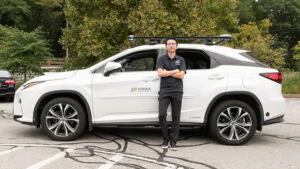
Purdue University assistant professor Ziran Wang stands next to a test autonomous vehicle that he and his students equipped to interpret commands from passengers using ChatGPT or other large language models. (Purdue University photo/John Underwood)
Approach and Results of the Purdue Study
An autonomous vehicle classified as level four, which is just one step short of complete autonomy according to SAE International, was used in a series of trials by the Purdue team to evaluate the potential of LLMs in driverless cars.
In order to educate ChatGPT to respond to a variety of commands, including more indirect ones like “I feel a bit motion sick right now” and more direct ones like “Please drive faster,” the researchers first trained the system to recognize Subsequently, they incorporated the learned model into the car’s pre-existing systems, enabling it to comprehend commands taking into account variables such as weather, traffic laws, and sensor data.
The experimental configuration was exacting. The majority of the testing was done on a former airport runway in Columbus, Indiana, which served as a safe high-speed testing facility. More parking trials were conducted in Ross-Ade Stadium’s lot at Purdue. The LLM-assisted AV complied with passengers’ pre-learned and new orders during the trials.
The outcomes were encouraging. Comparing participant experiences in level four AVs without LLM aid to normal experiences, participants reported significantly decreased rates of discomfort. Even when reacting to commands it hadn’t been specifically educated on, the car continuously beat baseline safety and comfort criteria.
The system’s capacity to pick up on and adjust to specific passenger preferences during a ride was perhaps its most astounding display, highlighting the possibility for really customized autonomous transportation.
Consequences for Traffic in the Future
The advantages for users are numerous. Natural communication with an AV lowers the learning curve that comes with new technology, making autonomous vehicles more approachable for a wider audience, including individuals who would find complicated user interfaces intimidating. Furthermore, the Purdue study’s personalization skills point to a future in which AVs will be able to adjust to individual preferences and offer a customized experience for every passenger.
Additionally, this enhanced engagement may increase safety. By gaining a deeper comprehension of passengers’ intentions and conditions—for example, identifying when someone is agitated or in a rush—AVs might modify their driving style to mitigate the risk of mishaps stemming from misunderstandings or unease among passengers.
Examining the AV market from an industrial standpoint, this technology has the potential to be a major differentiator. Providing a user experience that is more responsive and intuitive might provide manufacturers a considerable advantage.
Challenges and Future Directions
Before LLM-integrated AVs are widely used on public roadways, a number of obstacles still need to be overcome, despite the encouraging results. Processing time is one important concern. In non-critical settings, the existing system’s 1.6-second average reaction time to commands is adequate; nevertheless, in cases where prompt replies are needed, this could pose a problem.
The possibility that LLMs may “hallucinate” or misunderstand instructions is a serious worry as well. Although safety measures to reduce this danger were included in the study, a thorough resolution of this problem is essential for practical use.
Wang’s group is now investigating many directions for further study. They are comparing the performance of various LLMs, such as Meta’s Llama AI helpers and Google’s Gemini. Though official conclusions are still pending, preliminary data indicate ChatGPT now performs better than competitors in safety and efficiency criteria.
Conclusion
Large language model integration with autonomous cars is a turning point in transportation technology. This innovation tackles a significant obstacle in the adoption of AV by facilitating more intuitive and responsive human-AV interaction. Even if challenges like processing speed and misinterpretations still exist, the study’s encouraging findings open the door to a time when interacting with our cars may seem as natural as interacting with a human driver. As this technology develops, it could completely change not only how we travel but also how we view and engage with AI in our day-to-day activities.